Cloud-Based Custom CRM Benefits for Small Businesses
Let’s be honest for a moment.
If you are running your customer relationships on Excel spreadsheets, scattered WhatsApp threads, or a notebook on your desk — you are not just working harder than you need to. You are actively leaving money on the table.
In 2026, small businesses compete in a market where customers expect fast responses, personalised follow-ups, and a seamless experience at every touchpoint. The companies delivering that experience are not doing it manually. They have systems — specifically, cloud-based custom CRM systems — doing the heavy lifting in the background.
This blog breaks down exactly what a cloud-based custom CRM is, the seven core benefits it delivers for small businesses, and why investing in one now is far smarter than waiting until growth forces your hand
What Is a Cloud-Based Custom CRM?
A Custom CRM (Customer Relationship Management) system is software built specifically around your business — your workflows, your sales process, your team structure, your goals. It is not a generic template that forces you to adapt. It adapts to you.
When it is cloud-based, your entire system lives online. Your team can access it from any device, anywhere — all they need is an internet connection. No servers to maintain. No IT department required. No data locked on one office computer.
At DP Vision Analytics, this is what we build. Custom business software — CRM, ERP, HRMS, and LMS — designed for how your business actually operates today, and engineered to scale with where it is going tomorrow.
7 Benefits of Cloud-Based Custom CRM for Small Businesses
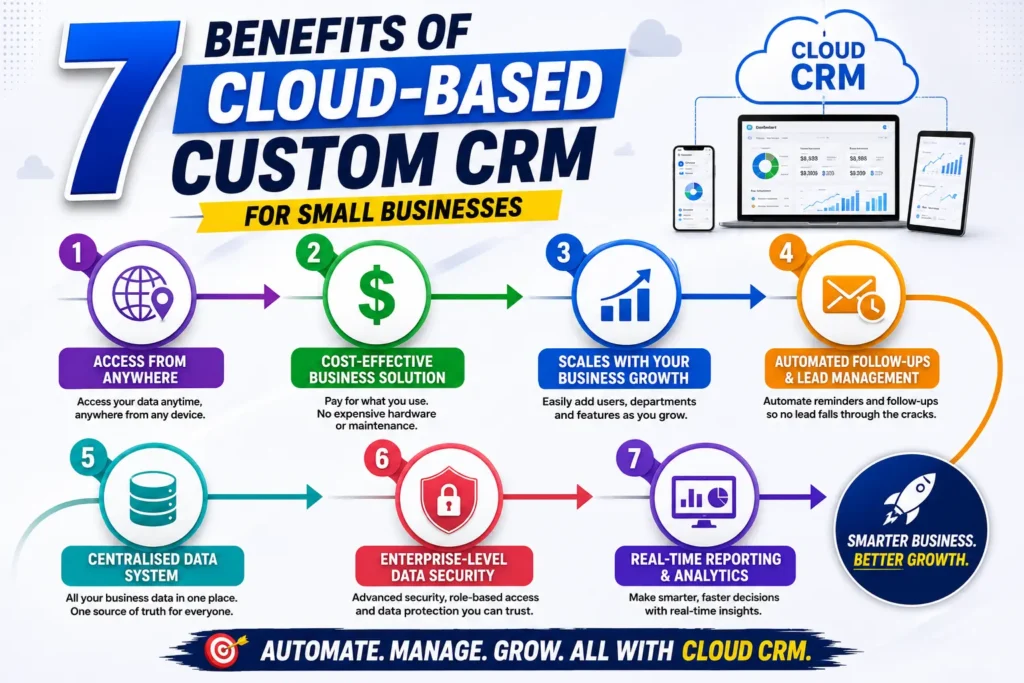
1. Access From Anywhere — Your Business Runs Even When You Don't
Your salesperson is in a client meeting across town. Your operations manager is working from home. You are at an industry event. With a cloud CRM, all three of you are looking at the same live data, in real time, from your own devices.
This kind of remote accessibility is not just a convenience — it is a competitive advantage. Deals get closed faster when your team has the right information at the right moment. Client issues get resolved quicker when history and notes are always at their fingertips.
Local, server-based systems tie your business to a physical location. Cloud removes that limitation entirely.
2. Cost-Effective — Pay for What You Actually Use
Traditional CRM setups come with a long bill before you even get started: physical servers, software licences, ongoing IT maintenance, and sometimes a full-time tech person just to keep things running. For a small business, that is a significant overhead for a system you might be using at 30% capacity.
A cloud-based custom CRM changes the economics entirely. There is no hardware to buy. Maintenance is handled by the provider. And because it is custom-built, you are not paying for a suite of features you will never touch — only the modules your business actually needs.
The result is a leaner investment that delivers more targeted value from day one.
This kind of remote accessibility is not just a convenience — it is a competitive advantage. Deals get closed faster when your team has the right information at the right moment. Client issues get resolved quicker when history and notes are always at their fingertips.
Local, server-based systems tie your business to a physical location. Cloud removes that limitation entirely.
3. Scales With Your Growth — No Replacement Required
Here is a scenario that plays out constantly: a business buys an off-the-shelf CRM, grows past its limitations in 18 months, and then faces the painful process of migrating to a new system mid-stride. Data gets messy. The team has to relearn everything. Growth stalls while IT sorts it out.
A custom cloud CRM is built to avoid this problem entirely. Adding new users, new departments, new workflows, or new integrations is a matter of extending what already exists — not replacing it.
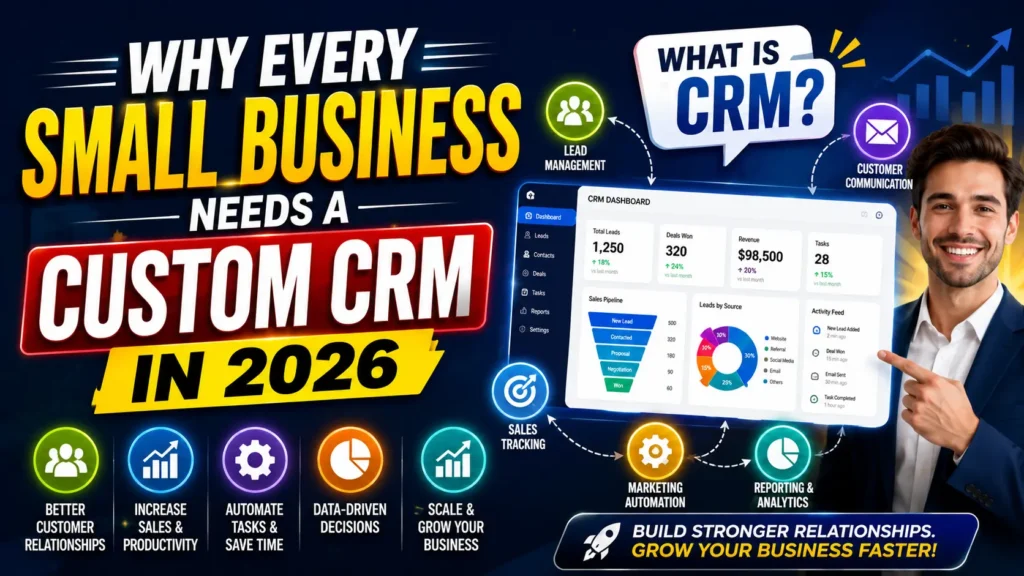
As we discuss in detail in our blog Why Every Small Business Needs a Custom CRM in 2026, building a scalable foundation early is not a luxury decision — it is the difference between smooth growth and expensive, disruptive system overhauls.
4. Automated Follow-Ups — Zero Leads Fall Through the Cracks
Ask any sales team where they lose the most deals and the answer is almost always the same: follow-up. Not because they do not care, but because they are managing too many conversations manually and something inevitably slips.
A well-configured custom CRM eliminates this problem. You set the rules once — follow-up reminders after X days, automated email sequences triggered by specific actions, task assignments routed to the right team member — and the system handles the rest.
This is not just about convenience. Sales automation for small businesses directly impacts revenue. When every lead gets followed up consistently and on time, conversion rates improve — often significantly.
5. Centralised Data — One Source of Truth for Your Entire Business
In businesses without a CRM, customer information lives in fragments: some in email threads, some in WhatsApp, some in a team member’s personal notes. When that team member leaves or gets sick, that knowledge walks out the door with them.
A cloud CRM centralises everything. Every call, every note, every deal stage, every communication history — stored in one place, visible to the right people, accessible at any time. Your business knowledge becomes institutional, not personal.
This also matters enormously when you start thinking about integrating other systems. A CRM that talks to your ERP for inventory and finance, your HRMS for team performance tracking, and your LMS for training your sales team creates a business that genuinely operates as a single, coordinated unit — not a collection of disconnected departments.
6. Enterprise-Grade Security — Your Data, Under Your Control
Data security is one of those things small business owners rarely think about until a breach happens. By then, the cost — in money, reputation, and client trust — can be severe.
Cloud-based CRM platforms use the same level of infrastructure that large enterprises rely on: end-to-end encryption, automated backups, multi-factor authentication, and role-based access controls. You decide exactly who on your team can see what data. Sensitive client financials do not need to be visible to your junior sales staff.
Custom-built systems take this further — security architecture is designed around your specific requirements, not a one-size-fits-all default configuration.
7. Real-Time Reporting — Make Decisions Based on Data, Not Guesswork
What is your best-performing lead source this quarter? Which customers have not been contacted in 60 days? What is your average deal close time, and how does it compare to last month?
Without a CRM, these questions require someone to manually compile data from multiple places — a process that is slow, error-prone, and usually happens too late to act on. With a cloud CRM, this information lives on a live dashboard, updated in real time, available to everyone who needs it.
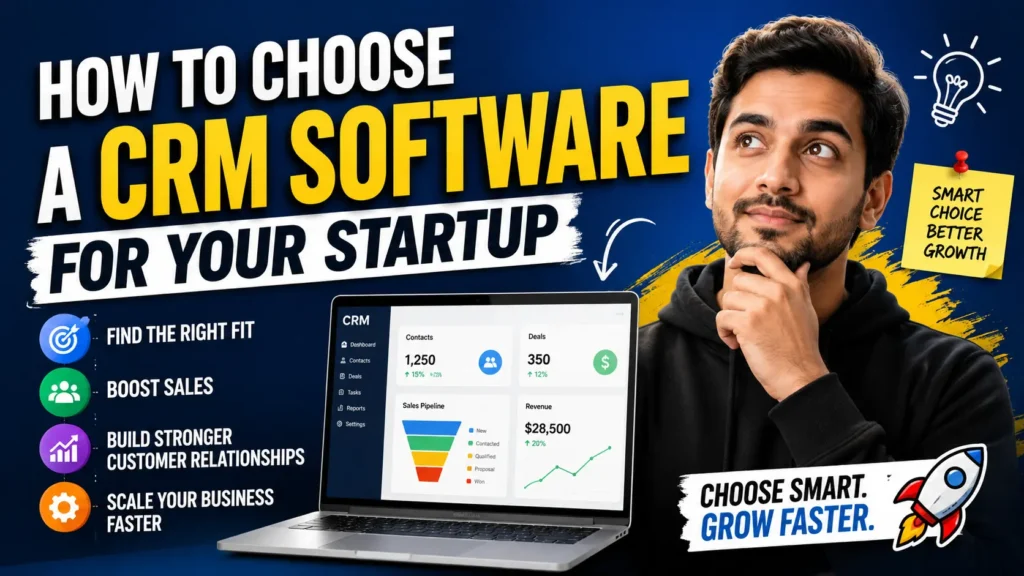
Data-driven decision making is what separates businesses that grow consistently from those that plateau. If you are currently evaluating your options, our guide How to Choose a CRM Software for Your Startup gives you a clear framework — from must-have features to the questions you should be asking every vendor before signing anything.
Which Small Businesses Benefit the Most From a Custom Cloud CRM?
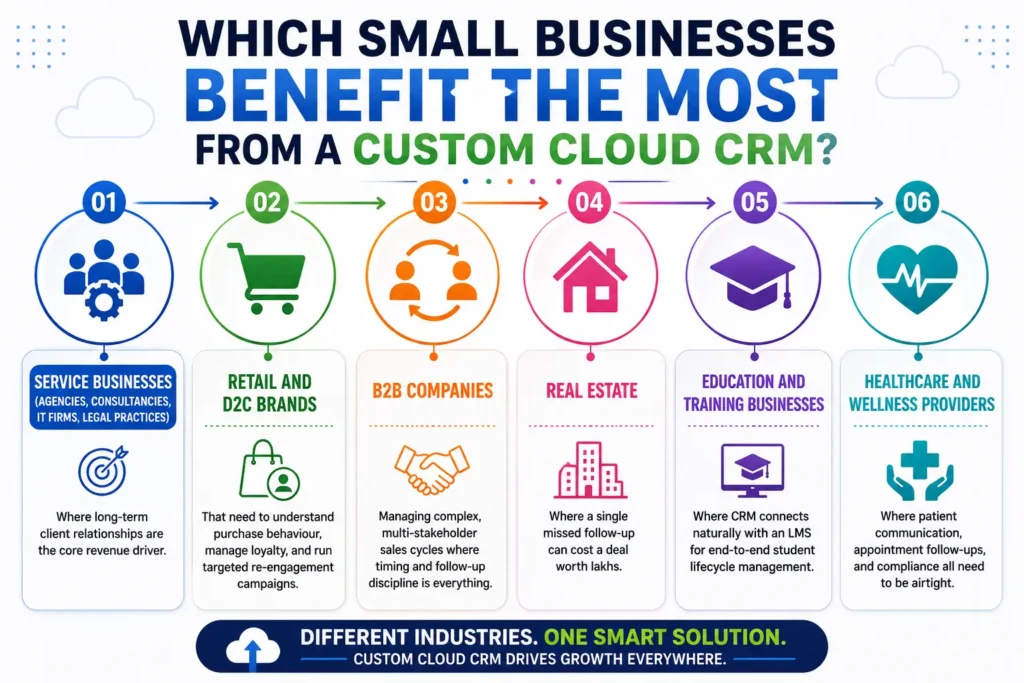
The short answer is: most of them. But some industries see results that are particularly immediate and measurable:
- Service businesses (agencies, consultancies, IT firms, legal practices) where long-term client relationships are the core revenue driver
- Retail and D2C brands that need to understand purchase behaviour, manage loyalty, and run targeted re-engagement campaigns
- B2B companies managing complex, multi-stakeholder sales cycles where timing and follow-up discipline is everything
- Real estate — where a single missed follow-up can cost a deal worth lakhs
- Education and training businesses where CRM connects naturally with an LMS for end-to-end student lifecycle management
- Healthcare and wellness providers where patient communication, appointment follow-ups, and compliance all need to be airtight
If your business involves customers, relationships, and repeat interactions — a custom CRM will deliver value. It is that straightforward.
Why DP Vision Analytics for Your Custom CRM?
At DP Vision Analytics, we do not resell templates or white-label generic software with your logo on it. We design and build from the ground up.
Our custom solutions include:
 Custom CRM — built around your sales process, your team, and your customer journey
ERP Systems — end-to-end resource planning that connects every department in your business
HRMS Platforms — smart workforce management from hiring to payroll to performance
Learning Management Systems — training and development tools that grow with your team
Every system we build is cloud-ready, secure, and designed to integrate with each other — so as your business grows, your software ecosystem grows with it seamlessly.
Ready to build something that actually fits your business?
Book your free consultation at dpvisionanalytics.tech →
Frequently Asked Questions
Yes — and often more cost-effective than the alternatives. Off-the-shelf CRM tools charge for full packages that include dozens of features most small businesses never use. A custom CRM is scoped precisely to what you need, which keeps both the build cost and the ongoing operational cost focused. Many businesses also find that the efficiency gains — fewer missed leads, faster follow-ups, less time on manual reporting — deliver a return on investment within the first few months of going live.
It depends on the scope and complexity of your requirements. A focused CRM with core features — pipeline management, contact history, automated reminders, and basic reporting — typically takes 4 to 6 weeks. More advanced systems that include integrations with ERP, HRMS, or LMS platforms, multi-user role structures, and custom analytics dashboards generally take 2 to 4 months. At DP Vision Analytics, we provide a clear, realistic timeline during your free initial consultation — no vague estimates, no surprises.
This is actually one of the strongest arguments in favour of custom CRM rather than against it. Because the interface is designed specifically around how your team works, there is no learning curve tied to features that are irrelevant to your business. The system looks and behaves the way your workflows do. We also deliver full onboarding support, training documentation, and post-launch assistance to make sure your team is confident from day one.
Absolutely. Data migration is a standard part of every CRM implementation we deliver. Whether your existing data lives in Excel files, Google Sheets, an old CRM, or a mix of all three — we plan and execute a thorough migration process so that every contact, deal history, and note is cleanly transferred into your new system. The goal is always a smooth handover where your team hits the ground running without any data loss or disruption.
The Bottom Line
A cloud-based custom CRM is not an expense. It is infrastructure — the kind that pays for itself through better conversion rates, stronger client retention, and smarter business decisions made with real data instead of gut feel.
Small businesses that build the right systems early do not just grow faster. They grow more sustainably — because their processes can handle scale without breaking down.
The businesses that wait until they are overwhelmed to build proper systems always pay more: in rushed decisions, in bad data, in team frustration, and in missed opportunities during the window when momentum matters most.
If you are serious about building a business that is ready for what comes next — let’s talk.