Do Startups Need a Customized CRM Solution?
I want to ask you something simple.
How do you currently track your customers?
Is it an Excel sheet? A bunch of sticky notes? Maybe a WhatsApp group? Or you signed up for some CRM tool but nobody on the team actually uses it properly?
If any of that sounds like you — don’t worry, you’re not alone. Most startups go through this exact phase. And most of them realize a little too late that their customer tracking system (or lack of one) was quietly costing them business.
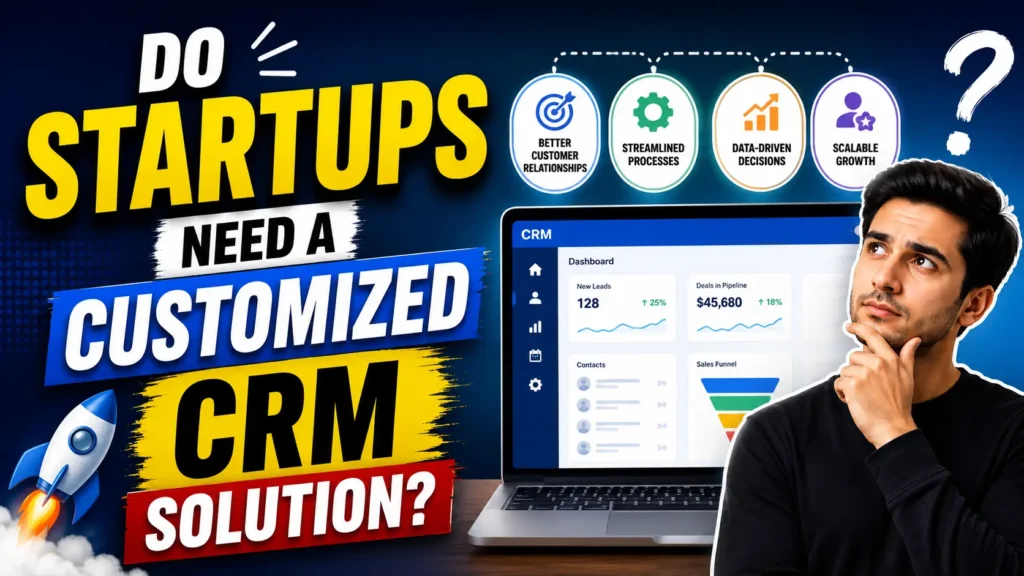
That’s what this blog is about. We’re going to talk about CRM — what it is, why startups need it, and whether a customized CRM actually makes sense for you or not.
No technical jargon. No sales pitch. Just a clear, honest conversation.
First Things First — What Even Is a CRM?
CRM stands for Customer Relationship Management.
But don’t let the fancy name confuse you. At its core, a CRM is just a system that helps you keep track of your customers and leads — who they are, when you last spoke to them, what they need, and where they are in your sales process.
Think of it like a very organized notebook for your entire business — except it sends you reminders, stores history, and gives you reports automatically.
Without a CRM, things fall through the cracks. You forget to follow up. You lose track of a deal. Two people from your team call the same customer on the same day. It’s messy — and mess costs money.
What's a "Customized" CRM — And How Is It Different?
When most people hear “CRM,” they think of big software tools like Salesforce, HubSpot, or Zoho. These are called off-the-shelf or generic CRMs. Anyone can sign up and start using them.
They’re decent tools. But here’s the problem — they’re built for everyone, which means they’re perfectly built for no one.
A customized CRM, on the other hand, is built (or set up) specifically for your business. Your pipeline stages. Your team structure. Your customer journey. Your reports.
It’s the difference between buying a readymade suit from a shop versus getting one stitched exactly to your measurements. Both cover you — but only one fits perfectly.
Why Startups Specifically Struggle With Generic CRM Tools
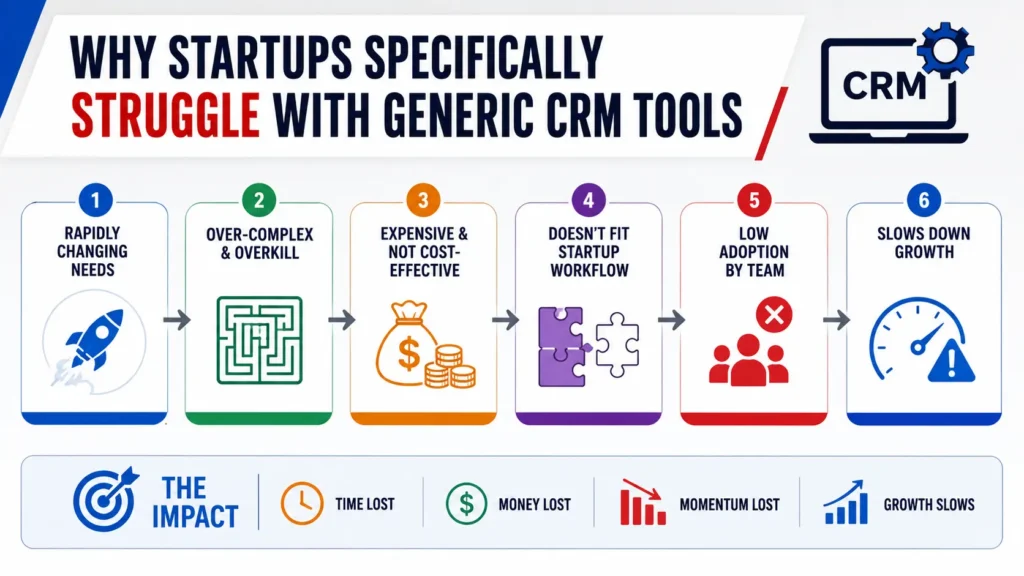
Here’s something I’ve noticed with a lot of startup founders. They sign up for a popular CRM, spend a week setting it up, and then… it just sits there. The team doesn’t use it. Data is still being maintained on spreadsheets on the side.
Why does this happen?
Because the tool wasn’t built around how they work.
A B2B software startup has a totally different sales process than a D2C food brand. A consulting firm works differently than an e-commerce company. But a generic CRM doesn’t know that. It gives you the same pipeline, the same fields, the same reports — regardless of what your business actually needs.
And when a tool doesn’t feel like it was made for you, people stop using it.
4 Real Reasons a Custom CRM Works Better for Startups
1. It Matches Your Actual Sales Process
You don’t have to squeeze your workflow into someone else’s template. A custom CRM is built around the stages your leads actually go through — from first contact to final payment. Every step is designed to match how your team operates.
2. It Connects With the Tools You Already Use
Your team probably uses a mix of tools — email, WhatsApp, Google Sheets, Razorpay, or some marketing tool. A custom CRM can connect all of these so data flows automatically. No more copy-pasting. No more switching between five tabs.
This is especially powerful when your CRM works alongside other systems like ERP for business operations, HRMS for your team, or LMS for training — everything talks to each other.
3. You Get Reports That Actually Help You
Generic CRMs give generic reports. But as a startup founder, you need very specific answers — Which lead source is converting the best? How long does it take to close a deal? Which team member needs support?
A custom CRM shows you exactly what you need to see — nothing more, nothing less.
4. It Grows as You Grow
When your startup scales, your processes change. New team members join. New products launch. New channels open up. A custom CRM can be updated to match your evolving needs — instead of forcing you to upgrade to an expensive plan or switch tools entirely.
"But Isn't Custom CRM Expensive?"
This is the most common question, and honestly, it’s a fair one.
Yes, building a custom CRM costs more upfront than subscribing to a generic tool for ₹2,000 a month.
But think about what that cheap generic tool is actually costing you:
- Hours wasted on manual data entry every week
- Deals lost because follow-ups were missed
- Subscription fees that keep rising as your team grows
- Zero visibility into what’s actually happening in your pipeline
When you add all of that up, a custom CRM often ends up being the smarter investment — especially when it’s part of a bigger system that includes CRM, ERP, HRMS, and LMS working together under one roof.
5 Signs You've Outgrown Your Current System
Not sure if you actually need a custom CRM? Here are five signs that should tell you:
1. Your team uses spreadsheets alongside the CRM — because the CRM “doesn’t quite work” for something important.
2. Follow-ups are being missed — because there’s no proper reminder system or clear ownership.
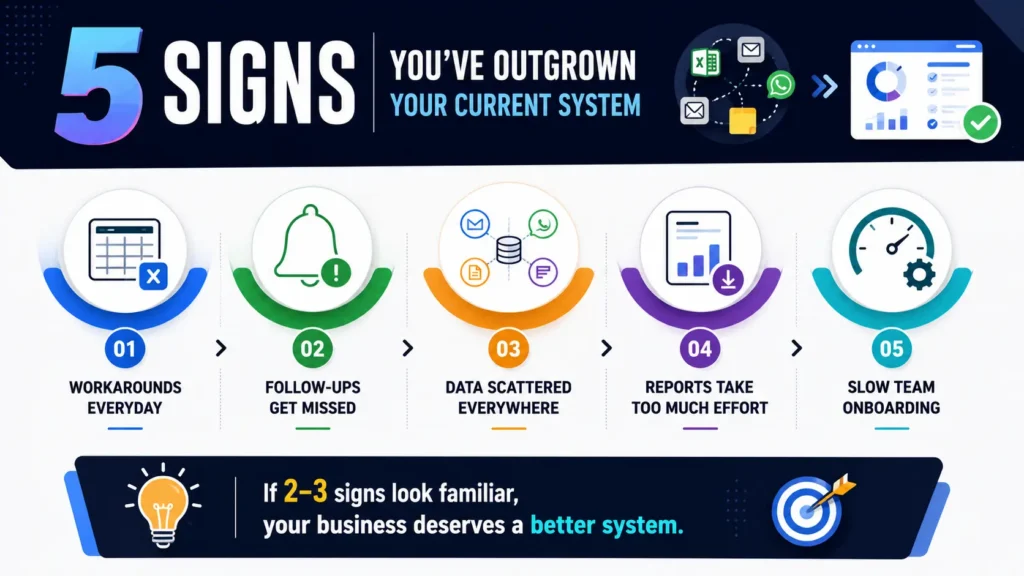
3. Customer data is scattered everywhere — email here, WhatsApp there, notes in someone’s phone.
4. You can’t pull a simple report without exporting data — because the system doesn’t show what you need.
5. New team members take too long to get up to speed — because the tool is complicated and nobody understands it fully.
If even two or three of these feel familiar, your current setup is already holding you back.
What to Look for When Choosing a CRM Partner
If you decide to go the custom CRM route, choosing the right team to build it matters a lot. Here’s what to look for:
- They understand your business, not just the technology. A good CRM partner asks about your process before they start writing code.
- They have integration experience. Your CRM should connect smoothly with your other tools — whether that’s email, payments, or systems like ERP or HRMS.
- They stick around after launch. Your needs will change. You need a partner who updates and supports the system over time.
- They build something your team will actually enjoy using. If the interface is confusing, nobody will use it — and that defeats the whole purpose.
At DP Vision Analytics, we build CRM solutions that are designed around how your startup works — not how a textbook says it should.
Let's Wrap This Up Simply
A CRM isn’t a luxury. It’s the backbone of your customer operations.
And the difference between a CRM that works and one that just sits there collecting dust is whether it was built for your business or for someone else’s.
Custom CRM isn’t just for big enterprises anymore. In 2026, startups that invest in the right tools early are the ones that scale faster, close more deals, and build better customer relationships.
If your current system — whatever it is — is making your team’s life harder instead of easier, that’s worth fixing. Sooner rather than later.
Frequently Asked Questions
Yes. You don’t have to build everything at once. Most startups begin with a simple version covering their core needs and expand later. The upfront cost is higher than a generic tool, but the time saved and deals recovered make it worth it.
With HubSpot, you’re adjusting an existing platform — you’re still limited by what it allows. A custom CRM is built from scratch around your exact workflow, with no restrictions on what you can add or change.
A basic CRM with lead tracking, pipeline, and reporting is usually ready in 6 to 10 weeks. More complex integrations with ERP, HRMS, or LMS take a bit longer.
Yes — that’s the whole point. Because it’s built around how your team already works, it feels familiar from day one. Most teams get comfortable within a day or two.
That’s expected — and a custom CRM handles it easily. Unlike a SaaS tool where you wait for the vendor to add features, your custom system can be updated anytime your business evolves.
Want to build a CRM that fits the way your startup actually works? Reach out to us at DP Vision Analytics — let’s have a simple conversation about what you need.
Book Your Demo
Related Posts You Should Read
If you’re thinking seriously about CRM for your business, these blogs will help you go deeper:
- 📖 Cloud-Based Custom CRM Benefits for Small Businesses — Why a cloud CRM isn’t just about convenience — it’s about staying competitive.
- 📖 How to Choose a CRM Software for Your Startup — A simple, step-by-step guide to picking the right CRM without getting overwhelmed.
- 📖 Why Every Small Business Needs a Custom CRM in 2026 — Things have changed. Here’s why this year is the right time to make the move.