Best ERP for Manufacturing in India 2026: What Factory Owners Really Need
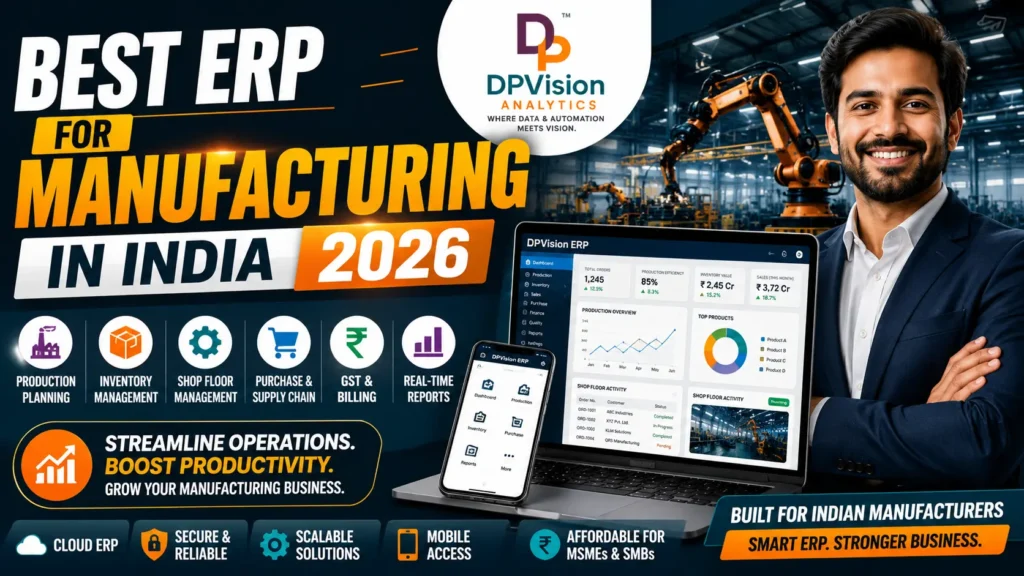
If you run a manufacturing business in India, you already know the daily struggle. Orders come in, raw material stock runs low without warning, machines report different numbers to different people, and by the time your GST return is due, someone is scrambling through spreadsheets. This is why so many manufacturers are actively searching for the best ERP for manufacturing in India 2026 — not because ERP is a buzzword, but because running a factory on paper registers and Excel sheets simply doesn’t scale anymore.
This guide breaks down what a manufacturing ERP actually does, the features that matter, and how to pick one that fits your factory instead of the other way around.
Why Manufacturing Businesses in India Need ERP in 2026
Indian manufacturing is changing fast. Buyers expect faster delivery. Compliance rules keep tightening. Competition, both domestic and international, keeps rising.
A manufacturing ERP software India businesses can rely on connects every department — production, purchase, inventory, sales, and accounts — into one system. Instead of five people maintaining five different spreadsheets, everyone works off the same real-time data.
This matters more in 2026 because customers now expect quick quotes, on-time delivery, and clean invoicing. Manual processes cannot keep up with that pace, especially once your factory crosses a certain order volume.
Quick Note: ERP isn’t only for large factories with hundreds of workers. Even a single-unit MSME with 15–20 employees benefits once inventory tracking, purchase follow-ups, and GST filing start eating more time than actual production management.
Common Problems Without ERP
Most factory owners don’t realize how much time and money they lose until they actually implement a system. Some familiar problems:
- Inventory mismatch — stock registers say one number, the actual godown shows another
- Production delays — nobody knows which machine or work order is running behind until it’s too late
- Manual reporting — someone spends half a day every week compiling numbers into Excel
- Purchase issues — raw material ordered late, or duplicate orders placed by mistake
- GST errors — invoices don’t match purchase records, causing mismatches during filing
- Data silos — the sales team doesn’t know what production knows, and accounts finds out last
- No real-time visibility — the owner only hears about a problem after a customer complains
Did You Know? Many Indian MSMEs still run core operations on a mix of paper registers, WhatsApp updates, and separate Excel sheets for inventory, billing, and production tracking. This is one reason government-backed initiatives like Digital India and support programs from the Ministry of MSME actively encourage small manufacturers to move toward digital systems.
Key Features of the Best ERP for Manufacturing in India 2026
Not every ERP is built the same way, and not every factory needs the same modules on day one. But if you’re comparing options, here’s what a genuinely useful manufacturing ERP should cover.
Production Planning
A good production planning ERP lets you schedule work orders, track machine and labour capacity, and avoid a last-minute scramble to meet delivery dates.
Inventory Management
A solid inventory management ERP keeps raw material, work-in-progress, and finished goods stock accurate in real time, so nobody places purchase orders based on guesswork.
Purchase and Sales
Automated purchase requisitions cut down duplicate orders and improve vendor tracking. On the sales side, your team should see the same order and dispatch numbers as the production floor, from quotation to delivery.
GST and Accounting
A GST compliant ERP India manufacturers can trust auto-generates GST-ready invoices and matches them against purchase and sales records, cutting down filing errors. You can always cross-check compliance rules on the official GST Portal.
Quality Control, MRP and Warehouse
Built-in quality checkpoints replace registers nobody updates. MRP tells you exactly what raw material you need and when, based on real production schedules, not rough estimates. And multi-location warehouse tracking with batch numbers keeps stock ageing under control.
CRM, Reports and Automation
Basic CRM tools track customer follow-ups and repeat orders, useful even for B2B manufacturers. Real-time dashboards replace static monthly reports, so decisions get made on current data, not last month’s numbers.
Whether your factory does discrete manufacturing (assembling distinct units like machine parts) or process manufacturing (continuous production like chemicals or food processing), these core modules apply, though the exact configuration will differ.
Benefits of Manufacturing ERP
Here’s a simple before-and-after comparison most factory owners relate to:
| Without ERP | With Manufacturing ERP |
|---|---|
| Stock counted manually, often wrong | Real-time inventory management ERP tracking |
| Production status known only at day-end | Live shop floor management software updates |
| GST filing done manually every month | GST compliant ERP India auto-generates ready invoices |
| Purchase orders based on guesswork | MRP-driven purchase planning |
| Owner relies on manager’s verbal updates | Real-time dashboards and reports |
| Departments work in isolation | One connected system across production, sales, purchase, accounts |
Here’s a practical example: a mid-sized auto components manufacturer using a proper production planning ERP can spot a delayed work order the same day, instead of finding out only when the dispatch deadline is missed. That one change often prevents penalty clauses and unhappy customers.
Pro Tip: Don’t try to automate everything on day one. Start with inventory and production modules first, let your team get comfortable, then add GST, CRM, and analytics in phase two. This is how most successful ERP for Indian manufacturers rollouts actually work.
How to Choose the Right ERP
Finding the best ERP for manufacturing in India 2026 comes down to matching real needs, not glossy brochures. This is where most owners get confused, because every vendor claims to be “the best.” Instead of chasing features you may never use, evaluate vendors against this checklist.
Checklist to choose the right manufacturing ERP:
- Does the vendor have real experience in the manufacturing industry, not just generic business software?
- Can the system be customized to your specific production process?
- Is it cloud-based, so you can check numbers from your phone, not just the factory desktop?
- What kind of support do they offer after go-live, not just during the sales pitch?
- Can it scale as you add more machines, more staff, or a second unit?
- Is the pricing transparent, with no hidden per-user or per-module charges?
- How is data security and backup handled?
- Is mobile access available for owners and supervisors on the move?
- How long does implementation typically take, and who supports it?
- Is training included, or is your team left to figure it out alone?
Key Takeaway: The best manufacturing ERP software in India isn’t the one with the longest feature list. It’s the one your team will actually use every single day, backed by a vendor who understands manufacturing, not just software.
If you’re also comparing this against general small-business software, our related read on the best ERP software in India for small businesses covers that comparison in more depth
Why DPVision Analytics is a Smart Choice
At DPVision Analytics, we work with manufacturers who are tired of chasing numbers across five different tools. Our approach to ERP is built around a few core ideas:
- AI-powered ERP workflows that flag issues, like inventory shortfalls or delayed work orders, before they turn into production problems
- Manufacturing automation for repetitive tasks like purchase approvals and reorder alerts
- Real-time dashboards so owners and managers see the same live picture, whether they’re on the shop floor or travelling
- Fintech integration for smoother GST, invoicing, and payment reconciliation
- Scalable architecture that grows with you, from a single unit to multiple production lines
- Custom workflows built around how your factory actually operates, not a rigid template
- Cloud deployment with GST-ready billing built in from day one
We’ve also been writing about where ERP is heading next, including how agentic AI is starting to change ERP automation, worth a read if you’re planning ERP investment for the next few years, not just this one.
You can also check our media coverage and press mentions to see how our work in this space has been recognized.
Our goal with every ERP for manufacturing companies in India that we build isn’t to sell a product. It’s to give factory owners one system that actually reflects what’s happening on their shop floor, in real time.
There’s no single “best” ERP for every factory. It depends on your production type, size, and budget. Look for a manufacturing ERP with strong production planning, inventory management, GST compliance, and cloud access. Vendors like DPVision Analytics build these around discrete or process manufacturing needs, rather than offering a generic one-size-fits-all package.
Small factories and MSMEs usually do best with a cloud-based ERP that starts with core modules like inventory, purchase, and GST billing, instead of a heavy, expensive system with unused features. An ERP for MSMEs in India should be affordable, quick to implement, and simple enough for a small team to run without a dedicated IT department.
Costs vary widely based on modules, number of users, and whether it’s cloud or on-premise. Cloud ERP for manufacturing is usually more affordable upfront since it’s subscription-based, while a custom ERP build costs more initially but fits your process exactly. It’s best to request a demo and quote based on your actual requirements.
Yes, for most Indian manufacturers, cloud ERP for manufacturing is a practical choice. It needs no heavy server investment, updates happen automatically, and owners can check production and inventory data from their phone, even while travelling. It also makes multi-location operations easier to manage from one dashboard.
At minimum, look for production planning, inventory management, purchase, GST-compliant billing, quality control, and reporting. More advanced systems add MRP, warehouse management, CRM, and real-time analytics. The right mix depends on whether you run discrete manufacturing or process manufacturing operations.
Conclusion
Choosing the best ERP for manufacturing in India 2026 isn’t about picking the flashiest software. It’s about picking a system that matches how your factory actually works, backed by a vendor who sticks around after implementation. Whether you run a small workshop or a multi-line production unit, the right ERP turns scattered data into one clear picture, and that clarity is what actually helps you grow.
Ready to Explore Further?
If you’re evaluating options, take a look at our ERP Solution built specifically for manufacturers, or get in touch with our team for a walkthrough based on your actual production process. No pressure, just a conversation about what would genuinely help your factory.
For more reads like this, visit our blog.