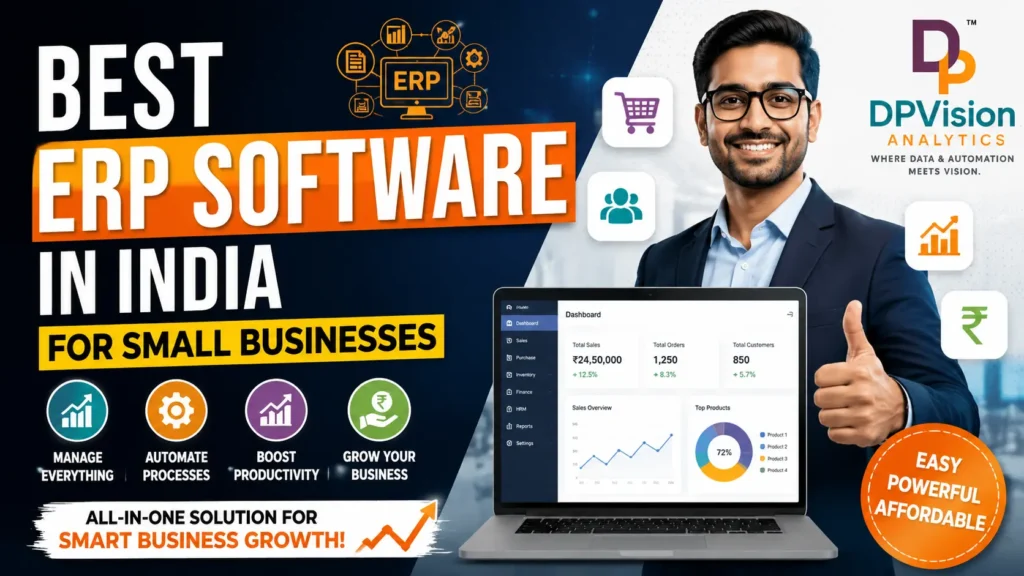
Best ERP Software in India for Small Businesses 2026
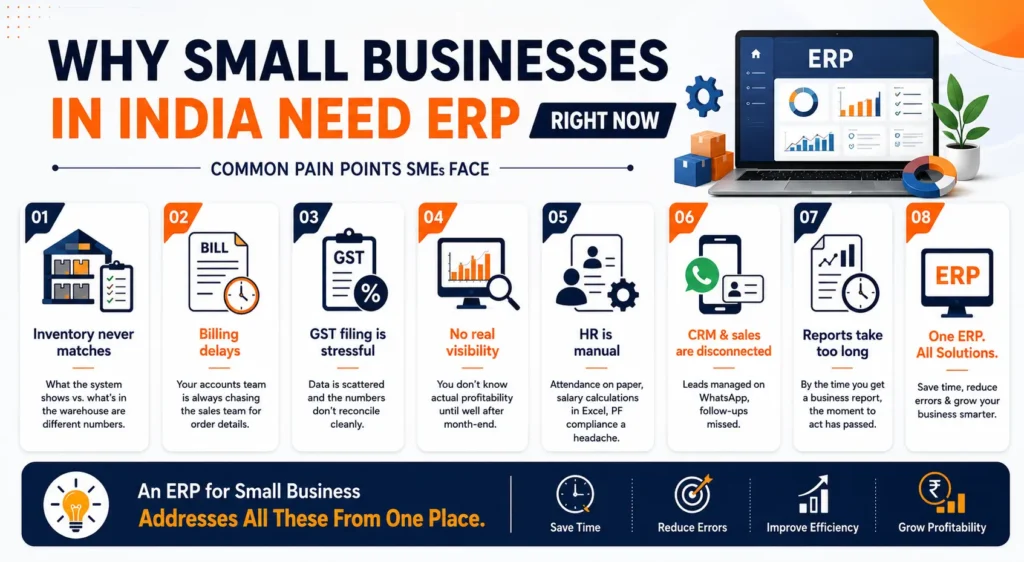
Running a small business in India in 2026 is a completely different challenge compared to five years ago. GST compliance has gotten stricter, customer expectations have gone up, e-invoicing is now mandatory for more businesses, and your competition is moving faster than ever.
Yet a surprising number of SMEs are still running on a patchwork of Excel sheets, WhatsApp forwards, and disconnected accounting software. The result? Missed orders, billing errors, GST filing stress, and no real-time picture of how the business is actually doing.
The best ERP software in India for small businesses solves exactly this. One platform. Every department. Real-time data. And in 2026, the better ones are doing it with AI automation built right in.
What is ERP Software?
ERP stands for Enterprise Resource Planning. In plain terms, it’s a single software that connects your entire business — sales, purchase, inventory, accounts, HR, and compliance — so every department works from the same data in real time.
When a sales order is created, your inventory updates. When goods are dispatched, the invoice generates automatically. When the month ends, your GST data is already reconciled. That’s ERP working the way it should.
It’s no longer something only large companies can afford or need. Cloud ERP software has made it practical, scalable, and affordable for small businesses and startups across India.
What’s Different About ERP in 2026?
This is where things have shifted significantly. A few years ago, ERP was mostly about digitizing your operations — replacing manual registers and spreadsheets. In 2026, ERP is doing much more.
AI is now embedded into ERP systems. Modern platforms can predict stock shortages before they happen, flag payment delays automatically, generate GST-compliant invoices without human input, and even send low-stock alerts to your purchase team.
The bigger shift is Agentic AI — AI that doesn’t just analyze, but actually takes action. It can match invoices to purchase orders, reorder stock when levels fall, route approval requests, and update records across departments without anyone clicking a button.
For small businesses with small teams, this is significant. You get the operational efficiency of a 20-person back-office team without actually needing one.
If you want to understand how this works in depth, this article on whether your ERP is ready for Agentic AI is worth reading before you make any ERP decision this year.
Key Features to Look for in ERP Software (2026 Checklist)
The market is full of options. Here’s what actually matters when evaluating ERP software for SMEs in 2026:
- Inventory & Warehouse Management — real-time stock, multi-location tracking
- GST-Ready Billing — auto GST invoices, e-invoicing, e-way bills
- Accounting & Finance — ledgers, P&L, cash flow, TDS, bank reconciliation
- Sales & CRM — leads, quotations, orders, payments in one view
- Purchase & Vendor Management — PO, GRN, vendor payments, credit tracking
- HR & Payroll — attendance, leave, salary, PF/ESI compliance
- Business Automation — reduce manual steps with workflow triggers
- AI Alerts & Predictions — low stock alerts, payment risk flags, demand forecasting
- Cloud Access — browser, mobile, any device, anywhere
- Role-Based Permissions — control data access by user role
- Custom Reports & Dashboard — see what your business needs, not a generic template
How ERP Actually Helps — Practical Business Examples
It’s easy to list features. Here’s what ERP actually does in day-to-day operations:
A trading business in Ludhiana was losing ₹3–4 lakhs every quarter in inventory discrepancies. After ERP implementation, purchase orders, GRNs, and sales orders were all linked. Mismatches dropped to near zero within 60 days.
A service company in Pune had a 25-day invoicing cycle — clients were billed almost a month after work was completed. ERP cut this to same-day invoicing with automated approval workflows.
A manufacturer in Rajkot was spending 4–5 days every quarter manually preparing GST returns. With GST ERP software, returns were ready in under an hour because the data was already clean and categorized.
These aren’t unique cases. They’re typical outcomes when businesses move from fragmented systems to a proper business management software.
How to Choose the Right ERP for Your Business
There’s no single “best” ERP. The right one depends on your industry, team size, and how you actually work. Here’s a comparison framework:
| What to Evaluate | What to Ask |
|---|---|
| Customization | Is it built around your workflow or will you adjust to fit it? |
| Cloud vs On-premise | Cloud is lower cost and more flexible for most SMEs |
| GST Compliance | Is it updated for e-invoicing and current GST rules? |
| AI & Automation | Does it reduce manual tasks or just digitize them? |
| CRM + ERP Integration | Can it manage leads and orders in the same system? |
| Mobile Access | Can you check dashboards from your phone? |
| Support Quality | Is support available in your language and time zone? |
| Implementation Time | How long before you’re actually live and productive? |
| Hidden Costs | Are there charges for modules, users, or updates? |
| Scalability | Will it still work when you double your team? |
The most common mistake: buying a big-brand ERP designed for enterprises and spending months (and lakhs) trying to customize it for a 30-person business. A custom ERP software built for your specific industry and workflow almost always delivers faster ROI.
Why DP Vision Analytics Is Worth Considering
If you’ve been evaluating ERP options and feel like nothing quite fits your workflow, DP Vision Analytics takes a different approach.
Instead of selling a standard product, they build custom ERP solutions designed around how your business already works. That distinction matters more than most businesses realize — especially when your process involves industry-specific steps that generic software doesn’t handle well.
Here’s what DP Vision brings to the table:
- Custom ERP Development — built from scratch for your industry and team
- Cloud ERP Software — accessible from any browser or mobile device
- Fintech ERP — for businesses with complex financial workflows and reconciliation needs
- AI-Powered Automation — workflows that act on data, not just display it
- CRM + ERP Integration — sales, leads, and fulfillment in one connected system
- WhatsApp API Integration — customer communication built into the ERP workflow
- Clean, Role-Based Dashboard — easy for your team to actually use from day one
- Scalable Architecture — built to grow with you, not be replaced when you do
Every business has different processes. A logistics company’s ERP looks very different from a manufacturer’s or a professional services firm’s. DP Vision builds for that reality rather than asking you to adjust your operations to fit a preset system.
They’ve also received recognition from multiple media platforms for their work in digital transformation — you can check their media coverage page to get a sense of their track record before reaching out.
For more articles on business technology, AI tools, and digital transformation for Indian businesses, their blog section covers practical topics worth bookmarking.
ERP (Enterprise Resource Planning) software connects your business operations — inventory, finance, HR, CRM, and compliance — into one platform. For small businesses in 2026, this means less manual work, real-time visibility, and AI-driven automation that reduces the team’s daily workload without adding headcount.
osts vary widely — from around ₹3,000–₹10,000/month for SaaS platforms to several lakhs for enterprise implementations. For small businesses, a custom cloud ERP from a local development partner often has a better cost-to-value ratio than licensing a large international product and paying separately for customizations and Indian compliance updates.
Yes — a properly built GST ERP software will auto-generate GST invoices, handle IGST/CGST/SGST, produce e-way bills, and support e-invoicing (now mandatory for more businesses in 2026). Always confirm that the ERP you’re evaluating is updated for the latest GST and e-invoicing regulations before committing.
For most small and mid-sized businesses in 2026, cloud ERP is the practical choice. No server infrastructure to maintain, automatic updates, mobile access from anywhere, and significantly lower upfront cost. On-premise still makes sense for businesses with very specific data security requirements or unreliable internet connectivity.
Conclusion
ERP in 2026 is no longer just about replacing spreadsheets. It’s about building a connected, automated business where your team spends time on work that matters — not on data entry, reconciliation, and chasing updates across departments.
The right ERP for your business is one that fits how you actually work, handles Indian compliance without manual effort, and has enough flexibility to grow as your business grows.
If you’re at the stage of evaluating options or want to understand what a custom ERP solution could look like for your specific business, the team at DP Vision Analytics is a good starting point. You can reach them directly through their contact page — no pressure, just a practical conversation about what your business actually needs.