Custom ERP vs Ready-Made ERP: Which Is Better in 2026?
Picture a garment exporter in Ludhiana who buys a popular ready-made ERP. Six months later, his team still tracks job work in Excel, because the software cannot handle his dye-lot flow. Now picture a Mohali business owner who spends eight months building a custom ERP, then finds half the features unused.
Both made an honest choice with the wrong information. So, custom ERP vs ready-made ERP: which is better in 2026? The answer depends on your processes, budget and growth plans. This guide compares both options with real numbers, so you can decide calmly. We have walked Indian business owners through this exact decision at DP Vision Analytics.
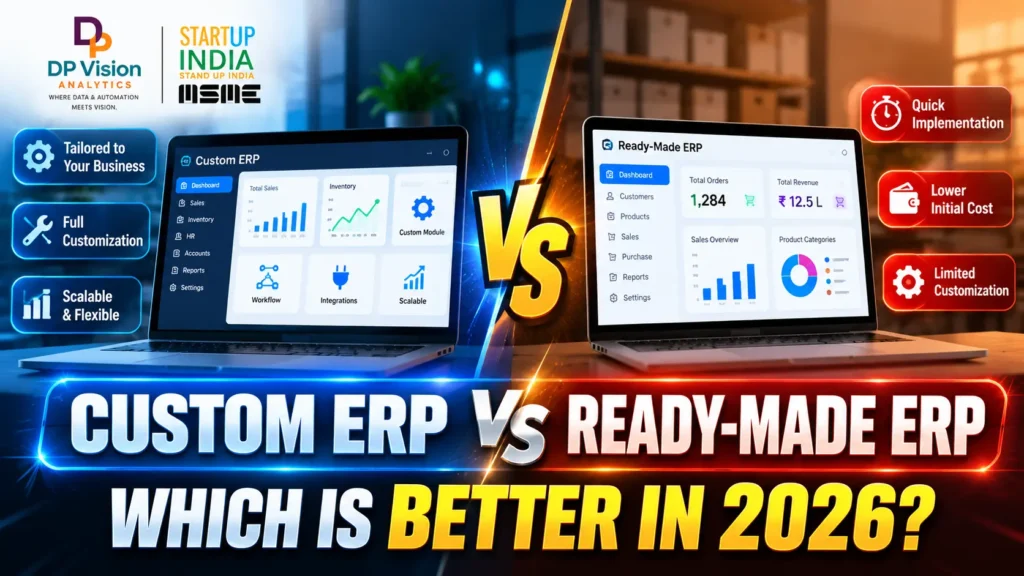
Quick answer: Choose a ready-made ERP if your processes are standard, you want to go live in weeks and your budget is tight. Choose a custom ERP if your workflow is your edge, or if off-the-shelf tools force costly workarounds. For many Indian SMEs, a hybrid (ready-made base plus custom modules) is the safest middle path in the custom ERP vs ready-made ERP decision.
What Is a Ready-Made (Off-the-Shelf) ERP?
A ready-made ERP is software built for many companies at once. You buy a licence or subscribe, configure it and start using it. Tally Prime, Zoho, SAP Business One and Odoo are common names in India. If you are a manufacturer, our guide to the best ERP for manufacturing in India shows how to shortlist one.
Most newer products are SaaS ERP: you pay monthly and log in through a browser. The upside is speed and a tested product, with GST updates and bug fixes coming from the vendor. The downside is fit. You bend your business to the software. Extra users, modules and add-ons also raise the bill quietly each year.
What Is a Custom ERP?
A custom ERP is built around how your business actually runs. If your factory handles job work, batch costing or multi-level approvals in its own way, the software follows that flow. You also own the code and data, so you are not stuck with one vendor’s roadmap.
The catch is time and discipline. Someone on your side must define requirements clearly, test builds and push staff to use the system. Textile units feel this gap most, since yarn lots, dye batches and challans rarely fit generic screens. We explain why in our piece on why textile businesses need a custom ERP in 2026.
Custom ERP vs Ready-Made ERP: Side-by-Side Comparison
Here is how the two options compare on the factors that matter most. Ranges are typical and approximate.
| Factor | Ready-Made ERP | Custom ERP |
|---|---|---|
| Upfront cost | Low (licence or subscription) | Higher (build cost paid first) |
| Time to deploy | 2–4 months | 5–9 months for the first version |
| Flexibility | Settings and add-ons only | Built around your workflows |
| Scalability | Pay for more users and modules | Scales as designed; needs good architecture |
| Integrations | Ready connectors for popular tools | Any system, via custom APIs |
| Data ownership | Sits on the vendor’s platform | Full control of data and code |
| Support | Vendor helpdesk, shared queue | A team that knows your system |
| Security | Vendor-managed, standard controls | Tailored controls, you must audit |
| AI readiness | Depends on vendor roadmap | Added on your timeline |
| Long-term TCO | Rises with users and add-ons | Higher at first, flatter later |
Custom ERP vs Ready-Made ERP Cost in India (2026)
Cost is usually the first question. Global data gives some context. Panorama Consulting’s 2024 ERP report found a median project cost of $450,000, though it covers global companies, not Indian SMEs. Its 2026 report found that more than a quarter of 170 surveyed organisations went over budget. Indian SMEs spend far less, but the lesson holds: hidden costs hurt.
The table below shows our estimated ranges in INR. They are approximate, based on market quotes, and not a price list.
| Business size | Option | Year 1 | 3 years | 5 years |
|---|---|---|---|---|
| Small (about 15 users) | Ready-made | ₹3–6 lakh | ₹6–12 lakh | ₹9–18 lakh |
| Small (about 15 users) | Custom | ₹8–15 lakh | ₹11–22 lakh | ₹14–28 lakh |
| Mid-size (about 50 users) | Ready-made | ₹8–18 lakh | ₹20–45 lakh | ₹32–70 lakh |
| Mid-size (about 50 users) | Custom | ₹20–45 lakh | ₹28–60 lakh | ₹35–75 lakh |
| Large (about 200 users) | Ready-made | ₹40 lakh–1.2 crore | ₹1.2–3.5 crore | ₹2–6 crore |
| Large (about 200 users) | Custom | ₹80 lakh–2.5 crore | ₹1.2–3.5 crore | ₹1.6–4.5 crore |
5-year TCO example: 50-employee manufacturing unit, 40 ERP users
Formula: TCO = upfront cost + (yearly running cost × 5) + hidden costs.
- Ready-made: licence at ₹1,800 per user per month comes to ₹43.2 lakh. Add setup ₹6 lakh, add-ons ₹6 lakh, integrations ₹2 lakh and training ₹1 lakh. Total: about ₹58 lakh.
- Custom: build ₹28 lakh, hosting ₹7.5 lakh, maintenance at 12% of build each year ₹16.8 lakh, training ₹1.5 lakh. Total: about ₹54 lakh.
The two land close by year five. So the real question is fit, not price. These are illustrative assumptions, not a quote. When you collect quotes from any ERP software company in Punjab, ask for a written breakup of licence, setup, training, support and upgrades.
Implementation Timeline: Which Goes Live Faster?
| Stage | Ready-Made ERP | Custom ERP |
|---|---|---|
| Requirement study | 1–2 weeks | 3–6 weeks |
| Setup or development | 3–8 weeks | 3–6 months |
| Data migration | 1–3 weeks | 2–4 weeks |
| Testing and training | 2–3 weeks | 3–5 weeks |
| Total to go-live | About 2–4 months | About 5–9 months |
Panorama’s 2026 report found a median project timeline of nine months across all ERP types, and almost a quarter of projects ran late. Delays often came from approvals and sign-offs, not the software. So name one decision-maker early.
When a Ready-Made ERP Is the Better Choice
Ready-made wins more often than software vendors like to admit. It is usually the right call if:
- your processes are standard (billing, stock, GST, payroll)
- you need to go live within a quarter
- nobody in your team can own a software project
- your budget this year is under roughly ₹10 lakh
A small trading firm with one godown rarely needs custom code. If a ₹3,000-a-month tool does the job, do not build anything. Start simple, learn what you really need, and revisit in two years.
When a Custom ERP Is the Better Choice
Manufacturing. A 120-person auto-parts maker with multi-stage routing, machine-wise costing and customer-specific quality checks will fight a generic tool every day. Our overview of ERP software for the manufacturing industry shows which modules matter most.
Textile. A 40-person textile unit in Ludhiana tracks yarn lots, dye batches and job-work challans. If the ERP cannot, Excel stays alive next to it, and nobody trusts either system.
Startups. A Mohali startup with an unusual product flow may want custom from day one. Most should start lean, though. Read our take on ERP for manufacturing startups to see how to phase it.
When custom is not worth it. Under 15 users, standard workflows, no internal owner? Skip it. Our note on whether startups need a customised CRM applies here too: start with the problem, not the technology.
The Hybrid Approach: Customise a Ready-Made Base
Many firms pick the middle road in the custom ERP vs ready-made ERP choice. They take an ERP platform and customise only what is different. You get proven accounting and inventory, plus custom modules for the parts that make you unique.
Be honest about the downside, though. Heavy customisation can make upgrades painful, and some licences limit what you can change. A good rule of thumb is to keep custom work to the workflows that truly set you apart, and insist on API access and data-export rights in writing. A partner offering custom CRM and ERP software development in Mohali can build these add-ons around your existing system.
ERP Trends in 2026 That Affect Your Decision
India’s ERP market keeps growing. Grand View Research estimates 2025 revenue near $3.4 billion, growing about 14% a year to 2033. Other publishers report very different sizes, from about $1.9 billion (IMARC) to $5.7 billion (Next Move Strategy Consulting). Treat every figure as a direction, not a fact.
- AI and agentic automation: ERP that takes action, such as raising a purchase order when stock runs low, is arriving. Check whether your system is ready for agentic AI before you sign.
- SaaS and cloud: vendors increasingly sell subscriptions. See how AI-powered SaaS is changing business software.
- Mobile-first: owners and supervisors now expect approvals on the phone.
- Compliance: GST and e-invoicing rules keep changing, so confirm who handles updates.
Stuck between the two? Chat with us on WhatsApp and get a quick, honest answer.
Decision Checklist: 10 Questions Before You Choose
Ask these before you pay anyone. Your answers will usually settle the custom ERP vs ready-made ERP question.
- Do our processes differ from the industry standard?
- How many users will we have in three years?
- Who will own this project inside the company?
- Can we afford the five-year cost, not just year one?
- What must it connect to: GST portal, payment gateway, machines, Tally?
- Do we need our data on our own servers?
- How will we train staff, and who will push adoption?
- Can we export all our data if we leave?
- Who handles compliance updates?
- What happens if the vendor or partner disappears?
Which Should You Choose? By Business Type
| Business type | Suggested route | Why |
|---|---|---|
| Small trader (under 15 users) | Ready-made | Standard flow, low budget |
| Growing SME, standard processes | Ready-made or hybrid | Fast start, room to add modules |
| Manufacturer with unique routing | Custom or hybrid | Generic tools break on shop-floor logic |
| Textile and job-work units | Custom or hybrid | Lot, batch and challan tracking |
| Early-stage startup | Ready-made first | Revisit at 18–24 months |
| Multi-unit or large company | Custom or heavily customised | Scale and control matter |
Other Systems That Work With Your ERP
An ERP rarely works alone. These systems often connect to it:
- HRMS: attendance, payroll and leave feed into costing. See our HRMS development work.
- LMS: trains new operators and tracks compliance courses through LMS development.
- Fintech tools: payments, lending and reconciliation through fintech software development.
- Lead CRM: sales enquiries flow into orders, as covered in our guide to a lead management CRM.
How DP Vision Analytics Can Help
We are a Mohali-based team that builds custom ERP, CRM, HRMS and LMS software for Indian SMBs and manufacturers. You can read who we are and how we work before you reach out. We have handled the hard parts of these projects: data migration, user adoption and change management. Those cause more failures than code does.
We start with a free requirement call, and we will tell you plainly if a ready-made tool is enough. Our work has also drawn media coverage and press mentions, if you want outside proof of how we operate.
After Your ERP Goes Live: Get More Customers
An ERP organises what you already have. Growth still needs new leads. Once stock, billing and dispatch run smoothly, you can handle more orders without chaos. That is the right time to push marketing.
SEO, Google Ads, Meta ads and content work well for B2B firms, but sales cycles are long. If you run a factory, see how we approach digital marketing for manufacturers and connect every enquiry to your CRM.
Final Thoughts: Custom ERP vs Ready-Made ERP in 2026
There is no single winner in the custom ERP vs ready-made ERP debate. Standard business, tight budget, quick start: go ready-made. Unique workflows and long-term control: go custom or hybrid. Whatever you choose, plan for data migration and staff training, because that is where projects slip.
Still unsure? Contact our team with your process details, or book a free demo and see what fits.
FAQs: Custom ERP vs Ready-Made ERP
Not always custom. Most small businesses with standard processes do well with a ready-made ERP, because it is cheaper and faster to start. Custom ERP makes sense when workflows are unusual. Check the best ERP software in India for small businesses before deciding.
A basic custom ERP for a small company usually costs ₹8–15 lakh to build, while mid-size systems often run ₹20–45 lakh or more. Yearly maintenance adds roughly 12–18% of the build cost. These are approximate ranges, and the final quote depends on modules, users and integrations.
A focused first version usually takes five to nine months, depending on modules and approvals. Panorama Consulting’s 2026 report found a median ERP project timeline of nine months across all types. Phased rollouts, starting with one department, cut risk and show results sooner.
Yes, and many do. Start with a ready-made ERP for finance and inventory, then build custom modules or a new system when limits appear. Plan data export, API access and contract terms early, because migration is often the costliest part.
Once operations run smoothly, growth needs demand. A full-service digital marketing team can run SEO, ads and social media, while a dedicated digital marketing agency in Mohali adds local reach for Punjab businesses. Tracking leads in a CRM keeps sales and ERP data connected.