
Why Your Textile Business Needs a Custom ERP in 2026
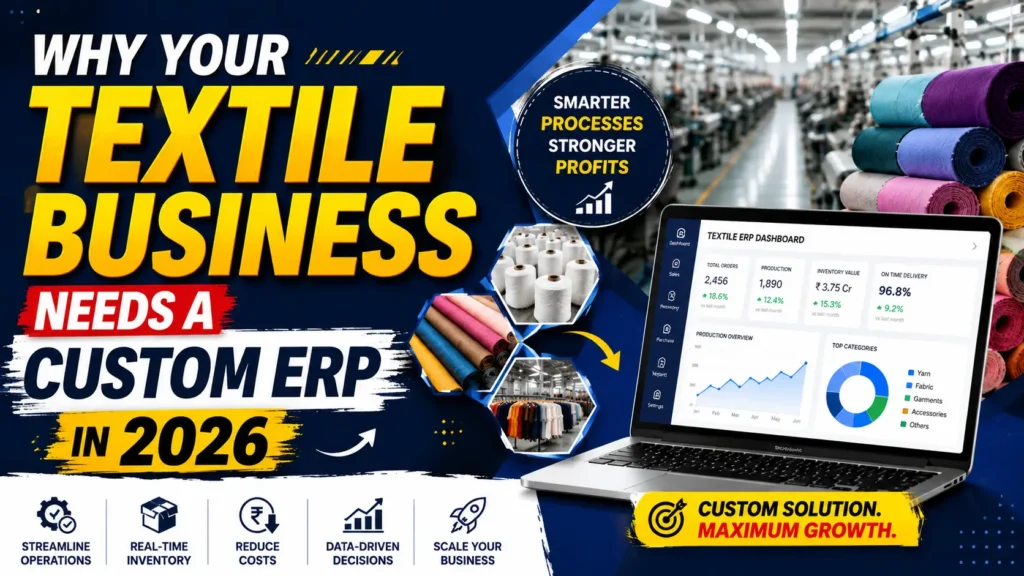
Running a textile manufacturing business in India is uniquely complex. You aren’t just moving boxes from a warehouse to a storefront. You are managing a chaotic, multi-stage production lifecycle that includes spinning, weaving, dyeing, and printing.
Most business owners we speak to are overwhelmed by tracking yarn variance and managing unpredictable seasonal demand fluctuations. Without strict oversight, you end up dealing with massive deadstock that quietly eats away at your profit margins. If you want a deep dive into how technology is reshaping this landscape, check out our latest business tech insights.
The harsh reality in 2026 is that spreadsheets and legacy software are no longer enough. Your competitors are automating their factory floors, and you need systems that actually understand how a textile unit operates.
The Failure of Generic ERPs in the Textile Industry
Many Indian textile owners make the mistake of buying off-the-shelf accounting software or generic enterprise systems. They quickly realize these platforms are built for standard retail or discrete manufacturing, not for the nuances of fabric. While these might rank among the top ERP software for small businesses in other sectors, they completely fail on the mill floor.
A generic system doesn’t understand dye-lot numbers or fabric shrinkage. It cannot track fabric rolls by weight, length, and width simultaneously. When your software cannot manage these highly specific parameters, your team resorts to manual workarounds, completely defeating the purpose of buying an ERP in the first place.
Core Reasons Why an Industry-Specific ERP is Crucial in 2026
To truly scale, you need a robust Textile ERP software in India designed around your specific factory workflow. Here is exactly why a specialized system is non-negotiable this year.
Precise Dye-Lot & Shade Tracking
Nothing ruins a production run faster than a mismatched dye lot. When a garment is stitched using fabric from two different shade batches, the final product is instantly rejected by quality control.
A custom system tracks every single roll back to its original dye lot, preventing mismatched garment production entirely. If you are just starting your manufacturing journey, prioritizing this feature is critical when looking for ERP solutions for manufacturing startups.
Real-Time Multi-Stage Inventory Management
Textile manufacturing involves transforming raw materials into entirely different units of measure. You buy raw cotton in bales, convert it to yarn in cones, and finally weave it into fabric in meters.
A specialized system tracks this complex transformation seamlessly across multiple warehouses. It acts as the best ERP for manufacturing in India, giving you real-time visibility from raw yarn procurement down to the finished, folded fabric.
Automated Production Scheduling & BOMs
Managing a Bill of Materials (BOM) for apparel is notoriously difficult. A single shirt style might require specific buttons, distinct thread colors, collars, and precise fabric cuts.
An advanced Apparel manufacturing ERP solution automates your production scheduling based on machine availability and worker shifts. It calculates exact raw material requirements, eliminating guesswork and drastically reducing material wastage on the cutting floor.
Future-Proofing with Automation & AI
The Best ERP for textile manufacturing 2026 doesn’t just record data; it acts on it. We are moving beyond simple cloud storage and entering the era of intelligent automation.
By upgrading to a modern Cloud ERP for apparel industry, you position your business to integrate with Agentic AI-ready ERP platforms. These systems can autonomously reorder yarn when stocks fall low or predict machine maintenance before a breakdown halts your weaving looms.
The DPVision Analytics Advantage
This is where standard software vendors fall short, and where DPVision Analytics steps in. We don’t just hand you a software license and wish you luck.
We operate like operational doctors. Our team steps onto your factory floor, diagnoses your specific bottlenecks, and engineers Custom textile software development solutions built around your workflows. We specialize in building customized CRM and ERP ecosystems that talk to each other flawlessly.
We pride ourselves on our deep understanding of the Indian textile market. You can learn more About DPVision Analytics and see why we have been heavily featured across major media and news platforms as a trusted digital transformation partner.
Stop Bleeding Margins—Automate Today
Relying on manual data entry and generic software is costing you money every single day. Lost inventory, delayed shipments, and production bottlenecks are symptoms of a business outgrowing its operational tools.
It is time to digitize, automate, and regain total control over your factory floor. If you are ready to modernize your textile operations, reach out to our consultation team today.
Take the Next Step:
Implementation timelines depend entirely on the complexity of your operations. However, a standard mid-sized textile unit can typically go live within 8 to 12 weeks with our streamlined deployment process.
Not at all. The cost of unchecked deadstock, fabric wastage, and delayed orders far exceeds the investment in a custom ERP. We design modular systems, meaning you only pay for the exact features your small unit needs right now.
Our engineering team handles the entire data migration process for you. We securely map and transfer your historical inventory, vendor data, and financial records into the new system with zero downtime.
Yes. Our custom ERPs can track individual worker output on the factory floor. This allows you to instantly generate accurate payroll calculations for piece-rate stitching and weaving operators.