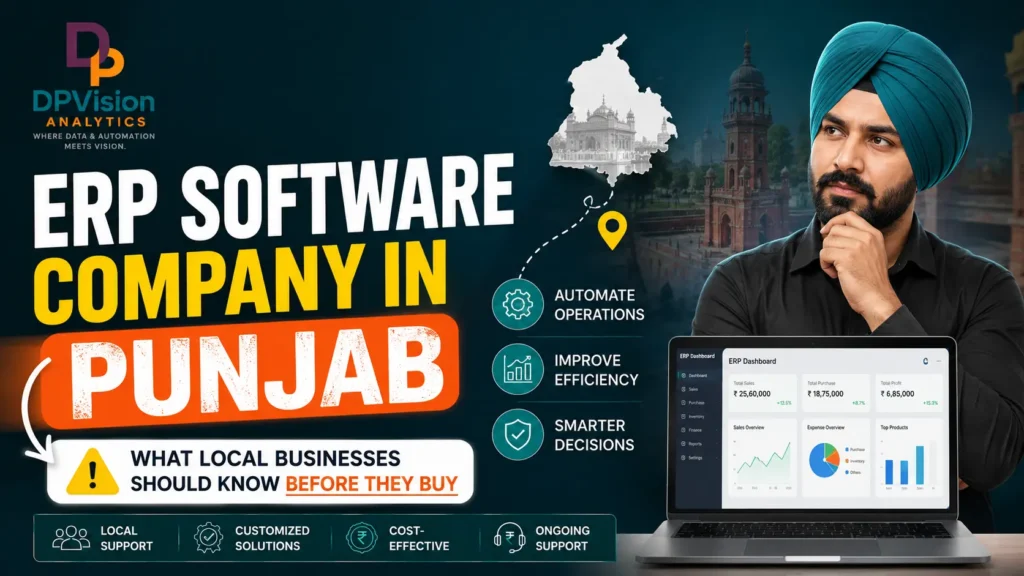
ERP Software Company in Punjab: What Local Businesses Should Know Before They Buy
Ask any factory owner in Ludhiana how they track raw material stock, and most will point to three things: an Excel sheet, a WhatsApp group, and a diary that’s falling apart at the spine. That’s not a dig at them. It’s just how a lot of Punjab’s manufacturing and trading businesses have run for years, and honestly, it worked fine when orders came from two or three regular buyers.
The problem shows up once the business grows. A Jalandhar sports-goods exporter juggling orders from Germany, the US, and a dozen domestic distributors can’t run production planning off a notebook. A Mohali-based electronics distributor with six sales reps and three warehouses can’t rely on someone remembering which invoice got paid last week. This is exactly where an ERP software company in Punjab earns its keep — not by adding more software for the sake of it, but by pulling scattered information into one place.
Why Punjab Businesses Actually Need ERP Software
Punjab’s economy runs on manufacturing, textiles, auto parts, and trading — businesses with a lot of moving parts: purchase orders, job work, inventory across locations, GST filing, payroll, and dealer networks. When all of that lives in separate spreadsheets and separate people’s heads, mistakes are inevitable. A Ludhiana hosiery unit might discover a fabric shortage only after a shipment date is already missed. A distributor might send stock to a dealer who hasn’t cleared last month’s payment, simply because nobody cross-checked.
Good ERP solutions for Punjab businesses fix this by connecting inventory, sales, purchase, accounts, and production into one system. Everyone works off the same numbers, in real time, instead of five different versions of “the truth.” If you run a textile unit specifically, it’s worth reading why textile businesses need a custom ERP in 2026 — a lot of the same problems apply, whether you’re weaving, dyeing, or stitching. And if manufacturing is your main headache, this piece on the best ERP options for manufacturing in India breaks down what actually matters on the shop floor.
What to Look for in an ERP Software Company
Not every ERP vendor understands SMB and MSME manufacturing the way Punjab’s industries need. Before signing anything, it helps to check a few things:
- Industry fit — Does the company understand textile, auto parts, or trading workflows, or are they selling the same generic template to everyone?
- Cloud vs on-premise — Cloud ERP works well for businesses with multiple locations or remote teams checking numbers from home. On-premise still makes sense for units that want data fully in-house. The right answer depends on your setup, not on whichever option the vendor prefers to sell.
- Support after go-live — A lot of ERP projects fail quietly in month three, once the sales team disappears and support tickets go unanswered.
- Room to grow — Your ERP shouldn’t need replacing the moment you add a new product line or a second factory.
- AI-readiness — ERP is changing fast, and it’s worth knowing if your system can handle agentic AI and automation down the line, instead of being outdated in two years.
If you’re comparing options for a smaller setup, this guide to the best ERP software in India for small businesses is a fair starting point.
Why a Local, Punjab-Based ERP Partner Matters
Searching “best ERP software company near me” isn’t just about convenience. A team based in Mohali or Ludhiana understands things an outsourced vendor in another state often misses — local GST practices, festival-season production spikes, dealer-credit cycles, or how a Jalandhar exporter’s paperwork differs from a Ludhiana domestic seller’s. When something breaks at 9 PM before a shipment deadline, you want someone who’ll pick up the phone, not a ticket number.
This is where DPVision Analytics comes in. Based out of Mohali, the team works specifically with Indian SMBs and MSME manufacturers, building custom ERP, CRM, HRMS, LMS, cloud telephony, and WhatsApp API tools rather than forcing every client into one rigid package. You can read more about who we are and how the team approaches projects, and check the media coverage if you’d like to see how the work has been received outside client conversations. For businesses that want their software built around how they already work — not the other way round — that’s usually the deciding factor over a bigger, more generic vendor.
How DPVision Analytics Fits Your ERP Needs
Whether you’re running a manufacturing unit, a trading business, or a growing service company, the approach stays the same: understand the workflow first, then build the ERP around it. Beyond core ERP, DPVision also builds connected tools that Punjab’s SMBs typically need alongside it — a custom CRM for handling leads and follow-ups, HRMS for payroll and attendance, and even fintech-adjacent tools for businesses that need tighter financial software support.
If you’re a manufacturing startup still figuring out which systems to invest in first, this guide for manufacturing startups is worth a look, and Mohali-based teams comparing custom CRM and ERP development options or looking to fix their lead management setup will find more detail there too. For more on how these systems come together, our blog covers it in depth.
It depends on how many modules and users you need, but custom ERP for SMBs is generally far cheaper than the big international platforms. Most Punjab-based small businesses end up paying a fraction of what a Tier-1 ERP vendor would charge, since the system is built around what they actually use.
For a small to mid-sized manufacturing unit, a working ERP setup typically takes a few weeks to a couple of months, depending on how many departments are involved. Simpler single-location setups move faster than multi-warehouse or multi-branch rollouts.
es — ERP built for manufacturing handles job work, raw material tracking, and production stages, which generic ERP software often doesn’t cover well. Textile units in particular benefit from modules built around dyeing, cutting, and stitching stages rather than a one-size-fits-all inventory screen.
ERP manages your internal operations — inventory, production, accounts, and payroll. CRM manages your customer-facing side — leads, follow-ups, and sales pipelines. Many Punjab businesses eventually need both, connected to each other.
The easiest first step is a short conversation about your current setup and where it’s breaking down. From there, it’s easier to say whether you need a full ERP, a lighter CRM, or both.
If your business in Ludhiana, Jalandhar, or Mohali is still running on spreadsheets and WhatsApp groups, it might be time for a proper system. Get in touch with our team, chat with us on WhatsApp for a quick answer, or book a free demo to see how it would actually work for your business.