How Custom ERP + CRM Solves Inventory & Job Work Challenges in Textile Manufacturing
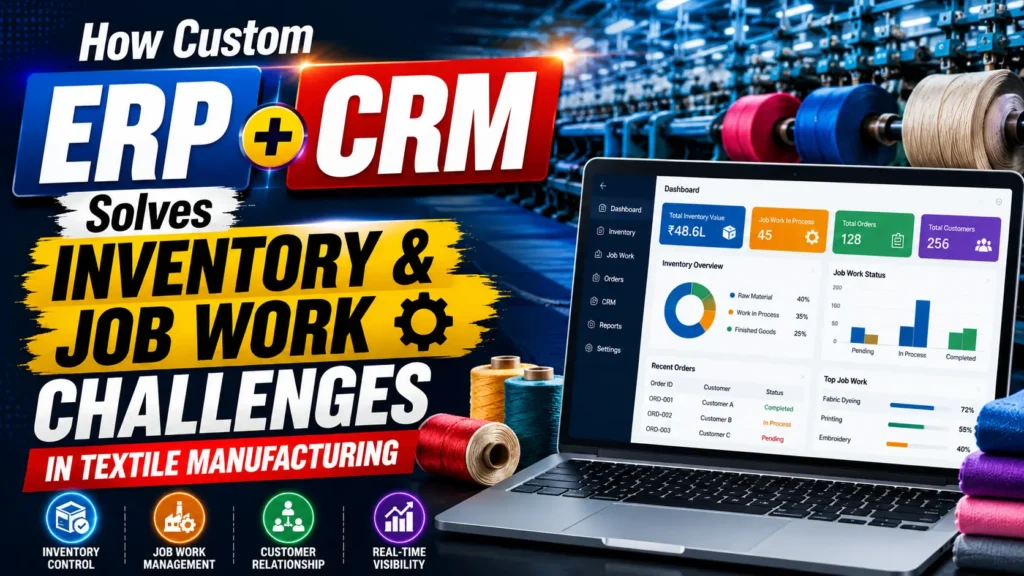
Run a fabric processing unit or a garment factory for a few years, and you learn one thing fast: the numbers on paper rarely match what’s sitting in the warehouse. Your register shows 4,000 metres of dyed fabric. The godown shows 3,200. Nobody is quite sure where the missing 800 metres went, and the job worker who processed the last batch insists he returned everything.
This is fairly normal life for textile manufacturers across India. Raw material tracking turns messy the moment yarn starts moving between your unit and two or three job workers, and production confusion builds when one department learns what another already knew — too late. Add an Excel sheet nobody trusts and zero real-time visibility, and the factory runs on guesswork.
A custom ERP and CRM solution fixes this — not by piling on more software, but by connecting what you already do into one system you can trust. For the broader picture, our guide on the best ERP for manufacturing in India covers the fundamentals; here, we go deep on what textile units specifically need.
Why Inventory and Job Work Become Difficult in Textile Manufacturing
Textile manufacturing isn’t one process. It’s a chain of them.
Yarn comes in, moves to weaving or knitting, goes for dyeing, comes back for processing, goes to a job worker for stitching or finishing, and finally lands in your finished goods warehouse — changing form, location, and often hands, at every stop.
A mid-sized unit in a cluster like Surat, Bhiwandi, or Tiruppur might run two or three warehouses at once — greige fabric, dyed stock, finished goods — while sending material out to five or six subcontractors for job work.
Track that across separate Excel sheets or paper registers, and every handoff becomes a place where inventory numbers drift. Nobody is quite sure whose responsibility a shortage is, and a delay at one job worker holds up dispatch three steps down the line. This is where stock mismatch and job work confusion begin.
Common Challenges Textile Manufacturers Face
Talk to enough production managers, and the same list comes up almost every time:
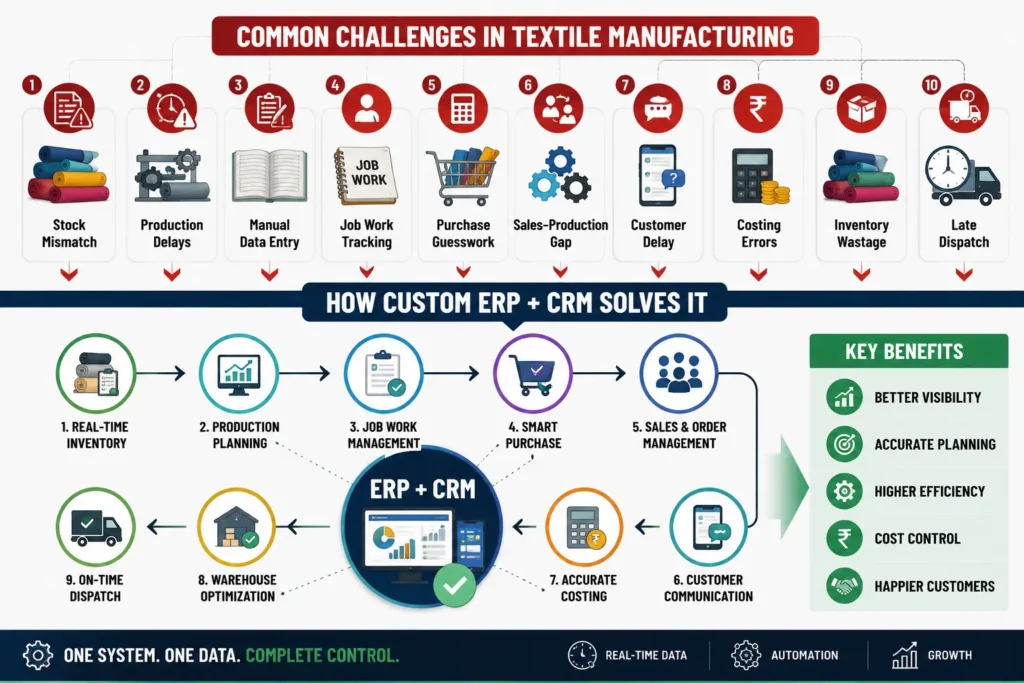
- Stock mismatch between the register and the actual warehouse count
- Production delays nobody flags until dispatch day is close
- Manual data entry across separate registers for yarn, fabric, and finished goods
- Job work tracking that runs on memory, phone calls, or a job worker’s own notebook
- Purchase planning based on guesswork instead of real consumption data
- Sales coordination gaps between what’s promised and what production can deliver
- Customer communication delays when nobody can confirm order status quickly
- Costing errors from unclear job work charges and wastage percentages
- Inventory wastage from fabric sitting too long in the wrong warehouse
- Late dispatch that quietly damages trust with buyers on their own deadlines
If your unit is still small and weighing its first ERP purchase, our related guide on best ERP software in India for small businesses is worth reading first.
How Custom ERP + CRM Solves These Problems
A custom ERP and CRM built for textile operations doesn’t just digitise your registers. It connects every stage of the process so information moves the way material actually does.
Real-Time Inventory Tracking
Every metre of yarn, greige fabric, or finished stock gets logged the moment it moves. Send 500 metres for dyeing, and the system reflects it instantly — and again the moment it returns. No more end-of-month shocks when the physical count doesn’t match the books.
Job Work Management
Job work is where most generic ERPs fall short, since they weren’t built with subcontracting in mind. A proper system tracks what left your factory, which job worker has it, and what’s expected back in quantity and quality — cutting disputes over shortages once both sides work off the same numbers.
Production Planning
Instead of discovering a delayed batch on dispatch day, your team sees which work order is running behind while there’s still time to act, based on real machine and labour capacity, not last week’s whiteboard.
Purchase Management
Raw material purchase ties to actual consumption and open orders, not a purchase manager’s memory. That means less over-ordering of yarn you don’t need yet, and fewer panic calls to suppliers mid-production.
Warehouse Management
One warehouse or five across different cities — a custom ERP gives you a single dashboard showing stock by location, batch, and shade. Moving fabric between a dyeing unit and your main warehouse gets logged automatically, not chased down over a phone call.
Sales & CRM Integration
Your sales team shouldn’t have to guess what production can deliver. When CRM and ERP share the same data, a salesperson quoting a delivery date looks at real stock and real timelines — the same idea we’ve covered for startups choosing a customized CRM solution: a system built around how your team actually sells.
Customer Order Tracking
A buyer asking “where is my order” shouldn’t send your team scrambling through emails and WhatsApp threads. Order status, from raw material allocation to dispatch, sits in one place your team can check in seconds.
Barcode Support
Barcode or QR tagging on rolls, lots, or cartons turns a five-minute manual stock check into a two-second scan, and removes the human error that creeps in when someone counts two hundred fabric rolls by hand late in the evening.
Reports & Analytics
Real-time dashboards replace the Saturday someone used to spend compiling Excel sheets. Inventory ageing, pending job work, wastage percentage, and costing variance are available whenever you need them. It’s also worth asking whether your ERP is ready for agentic AI, the next stage most manufacturers will face.
Mobile Access
Factory owners aren’t always on the shop floor. A cloud-based, mobile-accessible ERP lets you check stock, pending job work, or today’s dispatch status from your phone, even during a buyer meeting in Delhi or a visit to a second unit.
Why Choose DP Vision Analytics
Building ERP and CRM software for a textile business isn’t the same as building it for a retail shop or a services company — the stages, the job work cycle, and the costing structure are all different. At DP Vision Analytics, we build custom ERP and CRM systems around how your factory actually works, with automation and analytics built in from day one, so you get visibility you didn’t have before.
Every system we build scales with you, from a single unit to multiple factories, backed by support that continues after go-live — read more about our team on the About page. We’ve also been featured across several media platforms, covered here.
If stock mismatch, job work confusion, or late dispatch are eating into your margins, get in touch through our Contact page, and we’ll walk through your process first. You can also explore our latest blogs for more ERP and CRM insights for manufacturing businesses in India.
Textile ERP is software built for textile and garment manufacturing. It manages raw material, production, job work, warehouse stock, and accounts in one connected system instead of separate registers or spreadsheets.
It tracks every movement of yarn, fabric, and finished goods in real time. Stock updates automatically as material moves between warehouses, dyeing units, or job workers, so the register matches what’s actually on the floor.
Yes. A properly built ERP tracks what left your factory for job work, which subcontractor has it, expected return dates, and quantity received back — cutting the guesswork and disputes over missing or short material.
Because sales promises and production reality need to match. When CRM and ERP share data, your sales team quotes delivery dates based on actual stock and timelines instead of assumptions, and order tracking becomes far more reliable.
For textile manufacturing, usually yes. Ready-made ERP is built for generic businesses and often struggles with job work cycles, shade-wise stock, and lot tracking. A custom ERP is built around your actual process from the start.