Best Lead Management CRM in Mohali – Why Your Business Needs It Right Now
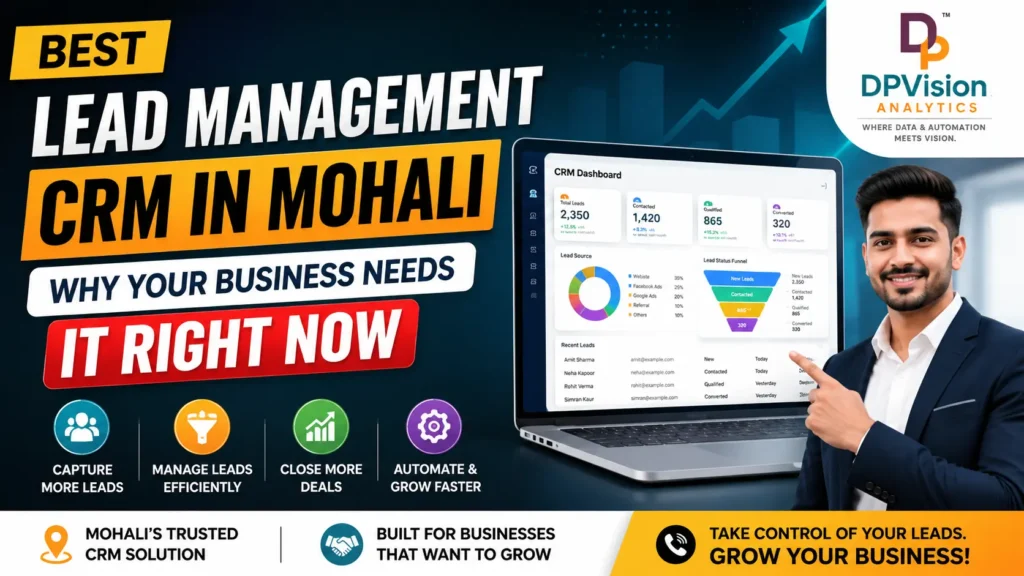
If you’re running a business in Mohali and still chasing leads through Excel sheets and WhatsApp messages, we need to talk. Seriously, you’re probably losing deals every single day without even realizing it. A solid lead management CRM isn’t just nice to have anymore—it’s what separates businesses that scale from those that stay stuck.
Let me tell you why.
Why Mohali Businesses Are Losing Deals (And Don’t Even Know It)
Here’s the thing about managing leads manually: it works until it doesn’t. You start with a few customers, everything’s fine, spreadsheets feel like enough. Then you get busier, your team grows, and suddenly nobody knows who called last week, which client was ready to buy, or why that deal fell through.
I’ve talked to dozens of businesses around Mohali—manufacturing units, trading companies, startups—and the story’s almost always the same. Leads slip through cracks. Promises get forgotten. Customers feel ignored. And the worst part? Nobody’s doing it on purpose. It’s just what happens when you don’t have the right system.
A proper CRM software for Mohali businesses changes this completely. It’s like having a personal assistant for every team member, tracking every interaction, every phone call, every email. No more “who was supposed to follow up with them?” No more lost opportunities.
What Actually Makes a Lead Management CRM Work
Here’s what confuses most people: they think all CRM software is the same. It’s not. The best ones have a few things in common though.
First, real-time visibility. Your whole team should be able to see where every lead is in your pipeline. Sales manager checking on the Mumbai client? Done in 30 seconds. Nobody needs to email, nobody needs to ask. This alone saves you hours every week. When you can see which leads are hot and which are cold, your sales cycle gets shorter. Simple as that.
Second, automation for repetitive stuff. You don’t want your team wasting time on follow-ups they could set on autopilot. Automatic emails when a lead goes cold. Reminders when someone needs to be contacted again. Your people should be doing what they’re actually good at—talking to customers, closing deals—not buried in admin work.
Third, actual data you can use. Who’s your best salesperson? Which products sell fastest? When do people usually buy? A good sales pipeline management system gives you these answers automatically. That’s how you make better decisions.
And honestly? It needs to be easy to use. If your team hates it, they won’t use it. And if they don’t use it, you’re wasting money.
The Lead Tracking Problem That Every Mohali Business Faces
Picture this: it’s 3 PM on a Friday. Your sales team’s been crushing it—eight new leads came in from your website today. But here’s the problem: where do they live? Who’s handling them? When’s the follow-up happening?
Without a lead tracking tool, these details live in someone’s head. Or worse, they don’t live anywhere at all. By Monday morning, half these leads have moved on to your competitor because they didn’t hear from you.
A real customer relationship management system fixes this instantly. New lead comes in? It’s automatically added to the system. Your team sees it. A task gets created. Follow-up happens on time. That’s how you go from losing deals to closing them.
For manufacturing businesses and trading companies in Mohali especially, this matters even more. Long sales cycles. Multiple stakeholders. One dropped ball and you’ve lost months of work. A CRM keeps every thread connected.
Should You Go Cloud-Based or Custom?
This is where it gets interesting. You’ve got two main roads here.
Off-the-shelf cloud CRM is fine for simple stuff. It’s quick to set up, reasonably priced, handles basic leads and customers. But here’s the catch: it usually works best if your business is pretty standard. If you’ve got unique processes—maybe you need to track multiple stakeholders, or you integrate with manufacturing systems, or you need custom workflows—it gets messy fast.
That’s where custom CRM solutions come in. Build exactly what you need. Integrate with your other systems seamlessly. Scale without hitting walls. Yeah, it costs more upfront, but if you’re serious about growth, it pays for itself within months.
At DPVision Analytics, we’ve built custom CRM and ERP solutions for businesses just like yours. The kind that actually fits how you work, not the other way around. Read more about why startups are moving to customized CRM instead of trying to force fit generic tools.
What Features Actually Matter for Lead Management?
Forget the fancy stuff nobody uses. Here’s what you actually need:
Lead capture: Leads from your website, email, WhatsApp, calls—should all land in one place automatically.
Automated follow-ups: Stop relying on someone remembering to call back. Set it and forget it.
Pipeline visibility: See every deal at every stage. Who’s winning, who’s losing, how long things take.
Team collaboration: Comments, notes, history—everyone on your team knows what’s happening with each lead.
Simple reporting: How many deals closed this month? What’s your average sales cycle? What’s working, what’s not?
Mobile access: Your sales team’s not always at their desk. They need to check and update leads from anywhere.
That’s it. You don’t need a 200-feature monster. You need something that solves your actual problem: turning leads into customers, faster.
Real Talk: How Much Does This Actually Cost You If You Don’t Have It?
Let me do some rough math. Say you’re a decent-sized business in Mohali. Fifty leads a month coming in.
Without a CRM, you probably convert maybe 10-15% of those. With a proper system, that jumps to 30-40% pretty easily. Why? Because you’re not losing anyone through the cracks.
Let’s say your average deal is worth 5 lakhs. The difference between 10% and 30% conversion is 10 extra deals per month. That’s 50 lakhs extra revenue every single month. And a CRM costs maybe 5,000-15,000 per month depending on what you pick.
You’re looking at ROI in weeks, not years.
For manufacturing and small business startups, this is even more critical. You’re competing with bigger companies. A CRM is how you punch above your weight.
Your Next Step
Here’s what you should do this week:
- Map your current process: How are leads coming in? Where are they going? Where are they getting stuck?
- Find a solution that fits: Don’t force a round peg in a square hole. If you need something custom, build it custom.
- Get your team involved: A CRM is only as good as your team’s buy-in. Make sure they understand why you’re making the switch.
Not sure where to start? We’ve helped a bunch of Indian businesses find the right solution. You can check our work and some of our press mentions, or jump straight to a demo.
Either way, stop wasting deals. Get a system in place.
Quick Q&A: Lead Management CRM Questions Answered
A: Nope. In fact, small businesses benefit more because they have less room for error. Even one lost deal hurts. A CRM helps you be lean and mean.
A: Most businesses see better conversion rates within 2-3 months, once their team is fully using the system. Some see it even faster.
A: Not necessarily. Cloud-based CRM is more flexible and cheaper to start. But custom CRM built for your specific needs often makes more sense long-term if you’re scaling fast.
A: You could integrate them. Some ERP systems have good CRM modules built in. It depends on your specific setup. Worth talking to someone who knows your industry.
A: Customer data is sensitive. Any CRM worth using should have encryption, regular backups, and compliance with Indian data laws. Ask your vendor directly about this.
Ready to talk? Chat with us on WhatsApp or book a quick demo here.