
How a Custom Textile ERP Can Automate Inventory and Reduce Manufacturing Costs
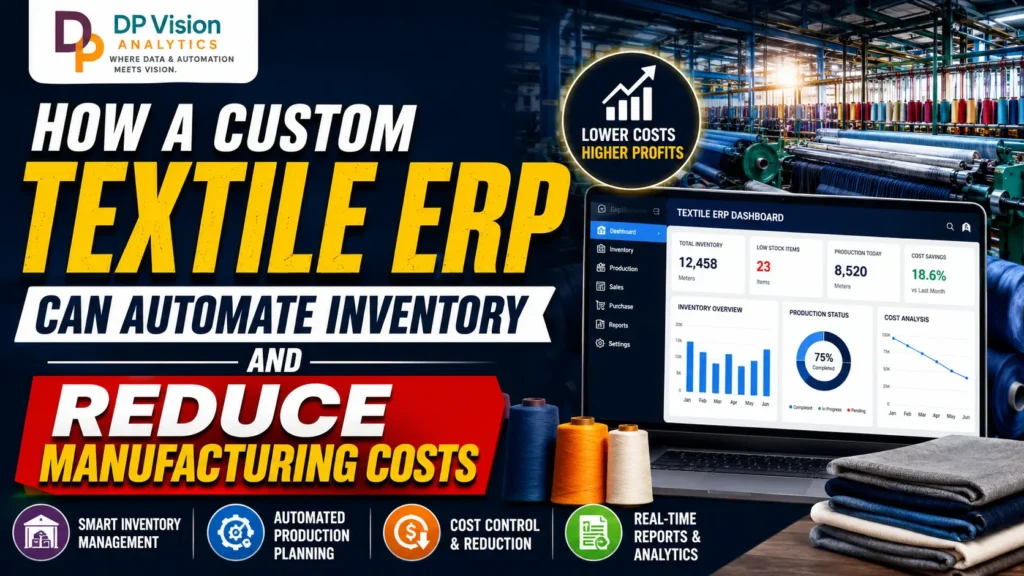
Walk into most textile manufacturing units in India and you will still find a register, an Excel sheet, and a supervisor who “just knows” how much yarn is left in the store. It works, until it doesn’t. A wrong count during peak season, a fabric batch that goes missing between the dyeing unit and the cutting floor, or raw material ordered twice because nobody checked the actual stock — these small gaps quietly eat into profit every single month.
This is exactly the problem a custom textile ERP is built to solve. Instead of forcing your business to fit into some generic software made for a different industry, a textile-specific ERP is built around how your unit actually works — yarn counts, fabric batches, job work, wastage tracking, and production stages that a regular accounting software was never designed to handle.
Why Textile Manufacturing Needs Inventory Automation
Textile manufacturing is not like retail or trading, where one product simply moves from shelf to customer. Raw material here goes through multiple stages — yarn to fabric, fabric to dyeing, dyeing to cutting, cutting to stitching — and at every stage, some material is used, some is wasted, and some is still sitting in a corner of the warehouse that nobody has updated in the system.
Without automation, this creates three recurring problems for manufacturers:
- Overstocking or understocking raw material because nobody has real-time visibility of what’s actually left
- Unaccounted wastage at each production stage, which directly increases the per-unit cost
- Delayed decision-making because owners are relying on data that is a week (or a month) old
A custom textile ERP removes all this guesswork by tracking inventory automatically, stage by stage, in real time.
What Exactly Is a Custom Textile ERP?
A custom textile ERP is a business management system built specifically for textile and apparel manufacturers, instead of a one-size-fits-all package. It understands concepts like yarn count, GSM, batch numbers, job work with third-party units, and multi-stage production — things a generic ERP simply doesn’t account for out of the box.
We’ve covered this in more depth in our detailed guide on why your textile business needs a custom ERP in 2026, which explains the specific gaps that ready-made software leaves open for textile units.
How a Textile ERP Automates Inventory Management
Here’s what automated inventory tracking actually looks like on the ground:
1. Real-time raw material tracking Every time yarn or fabric enters or leaves the store, the system updates automatically. No more end-of-day manual entries or “we’ll update it tomorrow” situations.
2. Batch and lot-wise tracking Each batch of fabric or yarn is tracked individually, so if there’s a quality issue or a customer complaint, you can trace it back to the exact batch, dyeing lot, or supplier — instead of checking the entire stock.
3. Automatic low-stock alerts The ERP notifies your purchase team before raw material actually runs out, so production never stops midway waiting for yarn or dye chemicals.
4. Job work and third-party processing tracking If fabric goes out for dyeing or printing to another unit, the ERP tracks exactly how much material was sent, what’s pending, and what has returned — a stage where most manual systems completely lose track.
5. Wastage and rejection tracking Every stage of wastage — cutting, stitching, dyeing loss — gets logged, giving you actual data on where material is being lost instead of estimates.
How This Directly Reduces Manufacturing Costs
Once inventory is automated, cost reduction happens almost on its own:
- Less capital blocked in excess raw material sitting idle in the warehouse
- Lower wastage percentage because every stage is now measured, not assumed
- Fewer production delays, which means labour and machine time is used efficiently instead of sitting idle
- Accurate costing per order, since raw material consumption is tracked against actual production, not rough estimates
We’ve seen similar cost savings play out across manufacturing units in our broader analysis on the best ERP for manufacturing in India 2026, and specifically for newer manufacturing setups in our post on the best ERP software for manufacturing startups.
Key Features to Look For in a Textile ERP
If you’re evaluating ERP options for your textile unit, look beyond just “inventory management” as a checkbox feature. A good system should offer:
- Yarn, fabric, and finished goods tracking in one dashboard
- Production planning linked directly to raw material availability
- GST-compliant billing and job work challans
- Integration with your CRM so sales orders automatically reflect in production planning — something we’ve explained in detail in our post on whether startups need a customized CRM solution
- Reports that are actually usable by your production manager, not just your accountant
For smaller textile businesses specifically, our guide on the best ERP software in India for small businesses breaks down what to prioritise on a limited budget.
What About the Future — Is This Just Software, or Something Smarter?
Modern ERPs are moving beyond simple record-keeping. Features like automatic reorder suggestions, predictive wastage alerts, and AI-assisted production planning are becoming standard in newer systems. If you’re curious about where this is heading, our article on whether your ERP is ready for agentic AI covers this shift in simple terms.
Why Textile Manufacturers Choose DPVision Analytics
At DPVision Analytics, we build custom ERP systems specifically for Indian textile and manufacturing MSMEs, instead of forcing your business into a generic template. Our team has worked closely with textile units to design inventory, production, and job-work modules that match how these businesses actually operate on the floor.
You can read more about our approach on our About Us page, and see where our work has been featured on our media and press mentions page. For more ERP and business automation insights, check out our blog section.
If manual inventory tracking is quietly costing your textile unit money every month, it’s worth having a quick conversation about what a custom system could look like for your specific process. You can message us directly on WhatsApp for a quick chat, or book a free demo call at a time that works for you. You can also reach out through our contact page for a detailed discussion.
A normal ERP is built for general trading or manufacturing and doesn’t understand textile-specific concepts like yarn count, GSM, batch tracking, or job work processing. A textile ERP is designed specifically around these workflows.
Yes. A good textile ERP tracks material sent for job work, what’s pending, and what has been received back, so nothing gets lost in the process.
Indirectly, yes. By tracking wastage and stock accurately at every stage, you avoid over-ordering, reduce material loss, and get a clearer picture of your real per-unit cost.
Custom doesn’t always mean costly. Many small and mid-sized units start with core inventory and production modules first, and add more features as the business grows.
It depends on the complexity of your production process, but most textile units can expect a phased rollout starting with inventory and production tracking, followed by other modules over a few weeks.